.comment-link {margin-left:.6em;}

Fruit Blog Header.jpg
APPLES - BRAMBLES - CITRUS - GRAPES - NUTS - PAWPAWS - PEARS - PERSIMMONS - STONE FRUITS - STRAWBERRIES - FORUM

Cherimoya
My cherimoya, shortly before it became smoothie fodder.

Archive of past images


AppleBorovinka


Chinquapin

Recent Cultivar Releases
Pomegranate

Current Work in Pomology

StrawbParkerEarle


QuinceBourgeat


Atom Feed

Powered by Blogger

Add to Technorati Favorites

May 29, 2011

Jackfruit article grumblings...

I think I'm becoming the Curmudgeonly Fruit Lord, but this bugged me:

Philippines: Unconventional breeding yields sweeter jackfruit (Freshplaza)

The article talks about "unconventional breeding", as though it was some novel, exciting approach. Yet when you read further, it turns out that "unconventional breeding" consists of driving around and looking for good-looking plants. That's neither novel nor breeding. Selection is a part of breeding, but it's not all there is to it.

And then we're supposed to be impressed that it was "developed" in just three fruiting years. Except of course they didn't actually develop anything...just picked a winner from the existing options.

Labels: , , ,

March 10, 2010

Pomegranate breeding and germplasm

Just stumbled up on a review of pomegranate genetic resources:

Pomegranate Plant Material: Genetic Resources and Breeding, a Review (CIHEAM)

I'm feeling a little grouchy tonight because a nursery lost my tree order (including pomegranates) and now the ones I want aren't available from where I wanted them until next year.

Labels: , , ,

March 9, 2010

This is pretty cool...

A guide to plant breeding programs in 36 different countries, many of which I've never heard of. Who'd have guessed there was so much breeding in Algeria, for example? These are nearly all developing countries, and I think it's encouraging to see these governments devoting scarce resources to these efforts.

National Organizations and Programs
(Plant Breeding Knowledge Resource Center)

Update: To be clear, I've heard of the countries, but not the breeding programs.

Labels:

March 7, 2010

What this strawberry needs is a name that says "dry and sandy"...

The University of California strawberry breeding program (the southern branch, based in Irvine) has released two new strawberry varieties, Benicia (formerly C225) and Mojave (formerly C227).

The southern California strawberry industry is kind of hurting these days, with increasing yields and increasing acreages (as well as competition from Mexico and elsewhere) pushing down prices and cutting into profit, so I'm sure these will be welcomed, though the last release from this program, 'Palomar', has not really caught on.

I've tried these varieties, when they were in limited trials, and I have to say I don't see any of them really setting the world on fire, though. The flavor was definitely better than 'Ventana', which is the current standard, but didn't exactly knock my socks off, and the fact that they're actually talking about how soft 'Mojave' is seems like a bad, bad sign. I'll take anything that pushes the quality standards above 'Ventana', which is an insult to strawberries, but since yields appear to be no higher they're not likely to be much of a fix for what ails the industry.

(And yeah, I've got a certain bias here, but I call 'em like I see 'em)

There's much more info on these in this presentation, but they're not named yet, so just look for the testing numbers (poor C226, so close to a shot at the big time).

Labels: , , ,

February 4, 2009

It's not as far north, but...

...it's a heck of a lot colder than London:

Don's Cold Hardy Citrus

Granted, they're not looking at grapefruit, but I'm duly impressed with anybody who can get an edible Poncirus hybrid. A very cool site, and a good resource for those interested in breeding cold-hardy citrus.

The site is set up in reverse blog fashion, with the new stuff on the bottom, which I find unreasonably distracting and odd.

(Todd Wert, a friend of mine from grad school, pointed this page out to me).

Also, here's a fun-looking citrus page in German, one of the users' pages from the forum page.

Labels: , , , ,

January 28, 2009

'WineCrisp' Scab Resistant Apple

The cooperative apple breeding program of Purdue, Rutgers, and University of Illinois (aka PRI) has a new release: Wine Crisp.

WineCrisp--New Apple 20 Years in the Making (University of Illinois)

I have a sneaking suspicion that the name is a thinly-veiled attempt to capitalize on the popularity of 'HoneyCrisp', but it's not like the University of Minnesota owns the concept of crispness I suppose.

The PRI cooperative has released a lot of varieties over the years, although probably the only one I ever saw with any frequency was Gold Rush (an interesting apple in that it is far better after months of storage than it is fresh, at least in my opinion). The main emphasis of the program has always been disease resistance, especially scab resistance. WineCrisp (and many other scab resistant cultivars) use the Vf gene.

I wrote up a whole big thing on the inheritance of major gene resistance to scab, but it got involved enough that I decided not to leave it attached to this, but rather to to A) finish it, and B) take advantage of actually having something written and available that fits as a "Fruit Genetics Friday" entry, so maybe I'll roll it out later this week.

Labels: , , ,

January 7, 2009

The most Mendelian of Mendelian segregation

This isn't really fruit related, but it is breeding related, so I declare it relevant:

Pea Breeding Project (Daughter of the Soil)

(I was inspired by the Agrobiodiversity Blog's mention of it, but I've been following Rebsie's blog for a while, so I'd have gotten around to it eventually.

Labels: ,

January 4, 2009

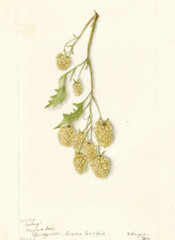
Primocane-fruiting black raspberries, revisited

I was pleased to find a note in my e-mail this morning from Pete Tallman, developer of the 'Explorer' black raspberry. I mentioned 'Explorer' two years ago (have I really been at this that long?) as an exciting development in a crop in which very little breeding has been done (and, frankly, very little breed success obtained).

Unfortunately, 'Explorer' has not really been a success. I've seen it twice, both times under tunnels: once in Pennsylvania, where it had virtually no fruit and a powdery mildew problem, and another time in upstate New York, where the plants looked healthier but fruit set was still poor, though better. I was rather disappointed, as I'd been pretty excited about the thing.

Tallman's message today explains a big part of the problem: 'Explorer' is not self-fertile. Apparently his field featured things that flowered and provided adequate pollen at the right time, so the problem was never evident under his conditions. This fits with what I saw: the tunnel at Penn State where I saw it had, if I recall, only one other variety in it, while the one in NY, where it had at least some fruit, had several.

While unfortunate, this isn't entirely shocking, as self-incompatibility is fairly common among wild, diploid Rubus, and 'Explorer' is not far removed from the wild source of the primocane-fruiting trait that Tallman discovered. (Not surprisingly, the trait hasn't persisted very long in most commercial types).

Anyway, all is not lost. Tallman has selected another primocane-fruiting black raspberry, dubbed PT-2A4, which does pass the self-compatibility test, and has other desirable traits compared to 'Explorer'. As he describes it:
"Compared to Explorer, the PT-2A4 berries are larger, higher drupelet count, and smaller seeds. PT-2A4 holds my all-time record for a single primocane black raspberry at 3.82 grams. Admittedly, that's a max berry, not an average, but I gotta track something, and average isn't awfuly interesting. Maybe with a little fertilizer this year I could break 4 grams. Unfortuantely, PT-2A4 hasn't captured the reduced thorniness of Explorer, so there remains further breeding down the road to see if I can tie that trait back in again."


He also included a link to his website, which includes a page for PT-2A4.

Labels: , , , , ,

New grape rootstocks from the University of California

Five new rootstocks from Andy Walker's breeding program at UC-Davis (cleverly named GRN-1 through 5):

New nematode resistant rootstocks for 2008 (Western Farm Press)

I was particularly pleased to see that GRN-1 is a hybrid of bunch grape and muscadine. Despite lots of talk about Euvitis/Muscadinia hybrids, there really haven't been many releases (I can only think of this and 'Southern Home', as well as maybe a few germplasm releases).

I don't know nearly as much about grape rootstock breeding as I do about the above ground part, but I always enjoy seeing how much wild material is used, and the completely different selection of species they're dealing with: V. champinii, rufotomentosa, monticola, rotundifolia, rupestris, and berlandieri, just in these five releases. Some of these (especially the first three) rarely if ever occur in the pedigrees of fruiting vines.

Labels: , , , ,

October 5, 2008

Now maybe we know why they were keeping the name a secret...

Maybe it's because it's kind of stupid: The new University of Minnesota apple release is named 'SweeTango'.

An Apple Is Born (Epicurious)

Plus: We've entered a new age! YouTube trailers for fruit cultivars!
SweeTango - A Sneak Preview (YouTube)


(Much thanks to the anonymous commenter who noted this on the post below...I thought it deserved more exposure).

All I can say is I hope the apple is better than the name. It's got an encouraging pedigree at least—Honeycrisp x Zestar.

Labels: , , ,

October 2, 2008

'Honeycrisp' and the U. of Minnesota Apple Breeding Program

Just came across a nice piece on the University of Minnesota apple breeding program:

With Honeycrisp's patent expiring, U of M looks for new apple (CityPages.com)

I thought the article was a decent "layman's" sort of overview of the UMN apple breeding program, and there's certainly plenty of interest in the program these days thanks to 'Honeycrisp', which has seen a surge of popularity unlike anything I've seen for an apple variety in my lifetime. 'Honeycrisp' at one point commanded an enormous premium, though massive plantings have begun to drive prices down (and there are those who consider it to have been grossly overplanted--many of the trees still due to come into production in the next few years. We'll see how that pans out...)

I like 'Honeycrisp' quite a bit, but I have a hard time believing it really ranks with Google as one of "25 Innovations That Changed The World" (Warning—PDF). It's certainly seen quite the burst of popularity, and yes, it's got an unusual texture, but its basically just a relative outlier on an existing scale of textures. I'm told there are other varieties with a similar breaking texture out there, such as 'Red Baron' (though admittedly I haven't had them). It's definitely good, and it's definitely interesting, but it's an incremental development, not a revolutionary one.

I think the argument is that it was revolutionary in the sense that it revitalized a lot of orchards in the Northeast and upper Midwest, particularly small family farms, and it did in fact do that to an extent. However, I think that's partly due to good marketing, and partly an element of "right place, right time". Full of varieties 50+ years old and little recent momentous development, the market was ripe for something new in the way of apples, and 'Honeycrisp' was distinct enough to fill that niche.

I'm still wondering what the newest UMN apple release is going to be named--last time I spoke to some one who'd heard the name, they treated it as though it was secret on par with a nuclear launch code (even while admitting it was being used freely in some circles). So it better be good.

Update: I noticed that the USDA site on 'Honeycrisp' that I linked to has old, incorrect pedigree--Macoun x Honeygold. This was disproven via molecular fingerprinting some years ago (this was actually the subject of the second Fruit Blog post ever). One parent is 'Keepsake', the other unknown.

I've been entertaining myself playing with grape marker data from the USDA, checking out possible parents for old American cultivars. That's how you know you're a big fruit geek--when you spend hours comparing pedigree data for fun...
Blogged with the Flock Browser

Labels: , , , ,

August 17, 2008

Traditional Ugandan crops disappearing

I hesitated a bit to post this, but I gave in because I really like the names and descriptions of all the traditional crops, and, whatever the cause, the issue is a serious one.

However I'm a little concerned about what seems a little bit like a misunderstanding of how hybrid seed works. It's common to hear people say "you can't save seed from hybrid varieties". This is true to the extent that these varieties won't come true from seed. However, you CAN get seed from these varieties, and, despite what the story describes, they generally will germinate just fine. The resulting seedlings won't be as uniform as the previous generation, and they probably, as a group, won't be as productive, but you could save seed for generations this way without problems (and in fact, if you did, it would probably eventually homogenize into more of a landrace and become increasingly uniform).

Hybrid varieties are distinct from the so-called "terminator" technology, which actually produced non-viable seeds (and also, despite the hype, was never actually implemented commercially). In theory I suppose it would be possible to find two inbred lines which when combined yield an F1 plant incapable of producing viable seeds, but it seems pretty unlikely, since genes encouraging sterility would hopefully be bred out of the breeding program.

There is a disturbing trend to characterize modern varieties as inherently pest-prone, fertilizer-intensive, and worse-tasting. They can be all those things, but so can traditional varieties. You get what you select for. I get really sick of the tendency to talk about plant breeding as a process which makes crops into finicky, crappy tasting garbage in exchange for yield. You absolutely can create varieties which taste as good (or better) than traditional varieties, produce more, and resist pests. In fact, plant breeding is the only way to get to that.

With those caveats, enjoy the akatunda akaganda, ebigaaga and obuyindiyindi:

Disappearing delicacies (Monitor Online)

Blogged with the Flock Browser

Labels: , , ,

August 15, 2008

July 2008 Fruit Patent Round Up

Fruit cultivar patent applications published last month....

KIWI:
'Skelton A16' - A moderately early, small-fruited kiwi variety from New Zealand. (You know, my company does it too, but doesn't it defeat the purpose of the patent comparing the new variety to other varieties if you compare it only to your own proprietary varieties, or in this case, breeding selections? I mean, the point is that you can establish identity by making comparisons--but if one interested party controls all plants of the relevant standards, doesn't that make it kind of pointless? (Not that the whole exercise isn't rendered about 98% moot by DNA fingerprinting...)
'Skelton A19' - Another moderately early New Zealand kiwi variety from the same program.
'Skelton X78' - Midseason kiwi variety, also from New Zealand from the same cross as A19.

APPLE:
'Lady Laura' - A limb mutant of 'Cripps Pink' featuring more intense and early coloration.
'Orion' - A Czech triploid variety from the cross of 'Golden Delicious' x 'Otava'.

SWEET CHERRY:
Royal Lynn - An early, low chill, cherry from the Zaiger program in Modesto, CA. From a cross between a proprietary selection and 'Royal Lee'.
PC8007-2 - A firm and flavorful sweet cherry variety from Washington State University.

PRUNUS (COMPLEX HYBRID):
'Coral-Cot' - Another Zaiger hybrid. Talk about complex! [[Prunus armeniaca x ((Prunus salicina x (Prunus salicina x Prunus armeniaca) x (Prunus salicina x Prunus armeniaca))] x Prunus armeniaca] Assuming I transcribed that right. It's something like that, anyhow. Basically, it's a pluot.

NECTARINE:
'Red Ryan' - A low chill Zaiger nectarine from a cross of a breeding selection and 'Red Roy'.

GRAPE:
'Sugrathirtythree- A seedless proprietary variety from the SunWorld program.

STRAWBERRY:
'Palomar' - A short day variety from UC, intended for the southern California production district. A cross of 'Camino Real' x 'Ventana'.

PEAR:
'Todd' - A russetted limb sport of 'Bosc'.

Labels: , ,

August 6, 2008

Plant breeding journal club

The Global Partnership Initiative for Plant Breeding Capacity Building is starting an electronic plant breeding journal club. The first installment is due tomorrow!

The GIPB has had a promising looking website for a while, but its really been kind of short on actual content so far. I'm hoping this is changing.

Anyway, there's a reasonable chance if you're here that you might be the sort that would be at least a little interested in discussing a plant breeding paper or two. If so, register and and join in. I'll be there!

Plant Breeding e-Journal Club (GIPB)
Blogged with the Flock Browser

Labels:

July 19, 2008

The Origin of the Tayberry - Joan Morgan's Fruit Forum

Since we're talking about SCRI and Rubus, I figured I'd pass along this link to a story I came across on Fruit Forum about the origins of the Tayberry (essentially an improved Loganberry), written by Derek Jennings, the breeder.

The Origin of the Tayberry (Joan Morgan's Fruit Forum)
Blogged with the Flock Browser

Labels: , , ,

July 18, 2008

June 2008 Fruit Patent Round-up

Here's an idea I had a while back--maybe it's painfully dull to some of you, but it's the sort of list I love clicking through. Here are the fruit cultivar patent applications published by U.S. Patent and Trademark Office last month:

APPLES:
'Emmons' - A chance seedling, probably of 'Golden Delicious' and (Red) 'Delicious'
'Galaval' - A whole-tree mutation of 'Galaxy' (a sport of 'Gala'), notable for its intense dark purple-brown color (This is desirable why, exactly?)
'McLaughlin Gala' - A limb mutation of 'Kidds D-8' (a sport of 'Gala'), with yellow skin and early ripening
'B. Thorne McIntosh' - A limb mutation of 'Starling' (a sport of 'McIntosh') which begins color 80 days (!) before the original.

CHERRIES:
'Rosie Ranier' - Interestingly, not a derivative of 'Ranier', but probably similar in appearance: a blush yellow cherry from a cross of 'Bing' x 'Earlisweet'

KIWIS:
'Hongyang' - A partially red-fleshed kiwi from seed of Actinidia chinensis var. rufopulpa, from China.

FIGS:
'Sequoia' - A large, green, fresh market fig from the cross 'Tena' x D3-1.

STRAWBERRIES:
'PS-5298' - A proprietary late season strawberry cultivar for the northern growing district of California.
'PS-5096' - Another proprietary late season strawberry cultivar for the northern growing district of California.

PLUMS:
'Vibehue99-1' - A chance sport of 'Angelino', with very dark skin, good flavor, and shipping quality.
'Suplumthirtyeight' - A very early Japanese plum variety from a cross of 92P037-130-001 x 'Suplumtwenty' (Got to love those SunWorld names...)

NECTARINE:
'August Lion III' - A large, late, yellow clingstone nectarine

GRAPEVINE:
'Sheegene-1' - A large, dark red, seedless table grape, from the cross 'Red Globe' x 'Princess'
'Sheegene-3' - A large, red, seedless table grape, from the cross 'Red Globe' x 'Princess'
'Sheegene-4' - A large, green, nearly seedless table grape, from the cross 'Red Globe' x 'Autumn Seedless'

LEMON:
'Eureka Seedless' - Seedless limb sport of 'Eureka'


Blogged with the Flock Browser

Labels: , , ,

July 12, 2008

The Murder of Nikolai Vavilov

The Washington Post has a review (or really, a historical piece inspired by a new book--the article doesn't really seem to be about the book itself) of The Murder of Nikolai Vavilov, by Peter Pringle, up online (apparently posted from the future, given that it gives July 13th as the date). I haven't read the book, but I know the basics of the story.

Vavilov isn't as well known as he should be, but his death is a symbol of a dark era in Soviet history, one whose effects were probably far greater than they are often given credit. Vavilov was a great botanist and geneticist, author of the modern theory of crop centers of origin and perhaps the greatest driving force behind a system of agricultural research which grew enormously in the early years of the Soviet era. He gathered germplasm from across the vast Soviet empire, he pushed to develop plant breeding across the country, and he studied genetics and heredity. This last would prove to be his undoing, as the rise of his rival Trofim Lysenko under Stalin strangled the study of genetics in the U.S.S.R. Lysenko took Vavilov's job, as the latter was shunned, defamed, and eventually, jailed, tortured, and killed by Stalin's secret police, and the strong foundation of research Vavilov had built was systematically dismantled in favor of Lysenko's junk science. Collections were lost, great scientists fired or killed, results suppressed, and a generation of students denied a real education in breeding. Soviet agriculture was plunged into a dark ages it has to some extent never recovered from.

Lysenko got about five minutes in my high school biology class and no time at all in history. Yet it the repeated failures of Soviet agriculture were one of the greatest stresses on the communist system, and one has to think that they contributed significantly to the eventual fall of the communist regime.

Labels: , ,

May 30, 2008

Fruit Genetics Friday #5: The Jostaberry

Most of my "Fruit Genetics Friday" posts have really been basically genetics posts with a little gloss of fruit thrown in to tie them into the prevailing theme. So I thought for a change I'd do something very specifically fruit-focused, a little more of a story of breeding than a genetics lesson.

Currants and gooseberries are both members of the genus Ribes, a group of fruit much appreciated in Europe but unfortunately often forgotten on this side of the Atlantic. I've heard a number of reasons suggested as to why Ribes fruit haven't really become big players in the New World, despite successfully adopting nearly every other major European fruit, and having a selection of wild Ribes of our own. I could (and, quite possible, might still) write a whole post on these, but I don't want to dwell on that in what is supposed to be a genetics post. Suffice it to say that if you're American and haven't had any of the fruits mentioned in this post, you're not alone. (But you are missing out).

Given their obvious morphological similarities, the idea of crossing currants and gooseberries probably occurred almost as soon as people began developing intentional hybrid fruit. No doubt more than a few attempts were fueled by the gooseberry breeding craze which swept England in 1800's (a worthy subject for a later post).Perhaps the first was the product of a Mr. W. Culverwell, an Englishman who in 1880 produced what was called Ribes culverwelli by crossing a black currant with a gooseberry. Producing hybrid seedlings turned out not to be too terribly hard, so long as the black currant was used as the female parent.

Such crosses yielded a range of diploid progeny, with a wide range of characteristics, some resembling their currant parent, some gooseberries, many somewhere in between. Unfortunately, they all had one thing in common: they were virtually sterile. Those that did set fruit did so parthenocarpically (ie, without fertilization) and so were dead ends when it came to breeding.

The Germans made some of the most concerted efforts, and in 1926 Paul Lorenz began making crosses at Berlin's Kaiser Wilhelm Institute. By World War II he had over 1,000 F1 seedlings growing, but unfortunately in the chaos and destruction of the war, only eight plants remained. In 1946, these survivors were incorporated into a program at the newly founded Erwin Baur Institute.

It was there that Rudolf Bauer finally struck upon a method of generating fertile hybrids between black currants and gooseberries. By treating the sterile hybrids with a solution of colchicine, he was able to restore fertility.

Here I'll slip into a little more science: Colchicine is an alkaloid derived from autumn crocus (Colchium autumnale) that has been put to a variety of uses over the years. Medically, it is used to treat both cancer and gout, although it's worth noting that it's teratogenic and widly toxic, two major downsides to any medicine (though manageable with adequate care). It's value in breeding was discovered in 1937 by Albert Blakeslee, who found that plants soaked in solutions of colchicine had multiple sets of chromosomes in their cells. Turns out, colchicine inhibits spindle formation during mitosis. So basically, the chromosomes double, but the cell fails to divide, resulting in a cell with double the normal complement of chromosomes.

This is pretty useful in and of itself: polyploid plants tend to be bigger, and that often includes fruit. Lots of crop plants are polyploid (the first Fruit Genetics Friday, #1b, featured polyploidy, so I won't dwell on its many virtues here). However, from a plant breeding point of view it's greatest virtue is perhaps the ability to restore fertility in "mule" hybrids. It does this by providing chromosomes with a mate to pair with in meiosis.

For example: Imagine that a normal black currant or gooseberry has three pairs of chromosomes (they don't, they have eight, but let's keep this simple), for a total of six chromosomes. Each gamete (pollen cell or ovule) will have three, one from each pair, and these will combine to form a plant with the normal three pairs. However, the gooseberry and black currant have diverged enough evolutionarily that the chromosomes no longer recognize each other. Because of this, they don't pair normally during meiosis and can't form viable gametes. The result is a sterile plant.

So imagine the chromosomes as shown below ('c'-black currant, 'g'-gooseberry, '='-successful pairing):


Black Currant:
1c=1c
2c=2c
3c=3c


Gooseberry:
1g=1g
2g=2g
3g=3g


Diploid F1 Hyrbid:
1c 1g
2c 2g
3c 3g


The chromosomes in the hybrid don't match up, so they don't pair. Colchicine gets around this by providing each chromosome with a mate, its exact duplicate:


Tetraploid F1 Hyrbid:
1c=1c
1g=1g
2c=2c
2g=2g
3c=3c
3g=3g


Using this strategy, Bauer was able to improve the fertility of those eight survivors, and use them as the basis for further breeding. Although the collection was once again cut back severely when the institute moved to Cologne, he eventually generated 15,000 fertile tetraploid hybrid seedlings. From these he selected three hybrids, which he dubbed 'Jostaberry' as a group ("Josta" comes from the beginnings of the common names of both species in German, Johannisbeere and stachelbeere). However, there has been some confusion since then, and Jostaberry has been distributed as single clone, despite the fact that it was originally three distinct genotypes (two of which were siblings). It is not clear which of the existing clones are the original three (assuming all three survive). In addition to the original 'Jostaberry' introduction to the U.S., the Corvallis repository has two other clones, and a Swiss nursery has named two others of uncertain origin, 'Jostina' and 'Jogranda', so it's possible the originals are still out there.

The Jostaberry has much to recommend it (although it requires lots of pruning and does still suffer some residual problems with fruit set), especially in its resistance to white pine blister rust and its lack of thorns, and there has been a little subsequent interest in improving it. George Waldo, working with USDA in Oregon, did some further breeding, but there has been little activity since then, hampered by low yields and a limited market. In addition to the varieties mentioned above, the only other slections circulating are perhaps a dozen ORUS selections from the USDA, some of which are still available in nursery catalogs. Although a minor fruit today, it remains an example of what can be accomplished with a clever breeding strategy.

Labels: , , , , , , ,

May 28, 2008

North Carolina Closing Experiment Stations?

This would be very upsetting if it happens:

Legislature looks at closing Castle Hayne agricultural research facility (StarNewsOnline.com)

Actually, it's more than just the Castle Hayne station--they're talking as many as seven of the 18 stations. I can't say I'm terribly surprised, as that's a lot of experiment stations for a state its size, but it's still disappointing. Castle Hayne has been an imporant center of fruit research, particularly blueberry breeding, for a long time, and it would be sad to lose that history. Hopefully the work going on there could be relocated.

Given the large and booming blueberry industry in North Carolina, and the success of the locally developed cultivars, it would seem a shame to hamstring the breeding program (and even if they move it, breeding programs for perennials rarely come through "moves" unscathed). The North Carolina program has released dozens of cultivars, many of which are important worldwide. 'O'Neal' remains the standard in early cultivars, planted on thousands of acres around the globe, while one of their first cultivars, 'Croatan', essentially saved the industry by introducing resistance to stem canker, and still represents a substanial part of the acreage.

Here's a presentation describing the NC State blueberry releases (they throw a few non-NCSU varieties in there, which is a little misleading, though it probably was less so when presented. The asterisks in the list on the last page distinguish the actual NC releases):

An Overview of Blueberry Releases from NCSU--and Other Cultivars of Interest to NC Growers (SmallFruits.org) PDF

Labels: , , ,

May 25, 2008

Vayro, Marinada, Constantí, and Tarraco Almonds

Four new late-blooming almond cultivars from Spain:

Vayro, Marinada, Constantí, and Tarraco Almonds (HortScience reprint, via IRTA)

Labels: , , , ,