Pomegranate Roads:
A Soviet Botantist's Exile from Eden
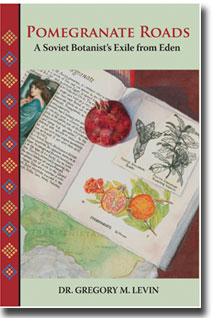
Dr. Gregory M. Levin
lllustrated, 216 pages
Floreant Press, 2006, $18
|
A few months ago, the folks at
Floreant Press were kind enough to respond to what was in hindsight some pretty unbecoming hinting on my part and sent me a review copy of
Pomegranate Roads.Pomegranates (
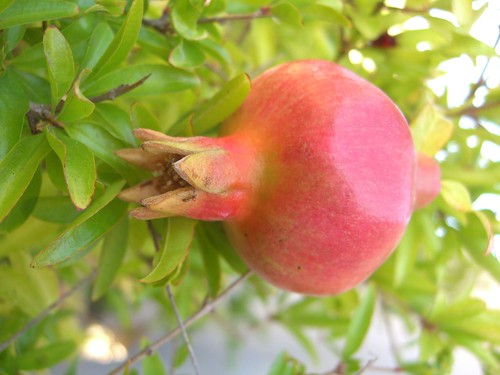
Punica granatum), despite their ancient and distinguished history, are not a fruit many people in the U.S. are terribly familiar with, nor is Turkmenistan a country that even enters the mind of the average American, except as a name on a map or a mention in a news story. Gregory Levin spent forty years researching this obscure fruit in that obscure country, and
Pomegranate Roads is the story not only of those four decades, but the rest of his life as well, stretching from his childhood experiences during the German siege of Leningrad, to his retirement to Israel, where he currently resides.
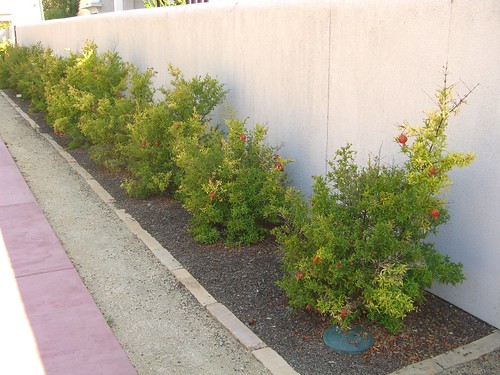
Perhaps the world's foremost authority of pomegranates, Levin was based for many years at the Garrigala Agricultural Research Station in Turkmenistan, then one of the component republics of the U.S.S.R. It was here, in an isolated enclave in the mountains along the Iranian border, that he assembled a collection of 1,117 pomegranate genotypes, from ancient cultivars to unusual mutant strains (some discovered in the wild and some generated himself). The book describes his thirty years of annual expeditions to collect germplasm, journeys which would take him
to twenty-seven countries,(
Update: Levin's collection covered 27 countries, but Levin himself never left the U.S.S.R. on his collection trips) through wild country sometimes wracked with ethnic and political violence, gathering not only wild specimens but also cultivated types found in fields abandoned in the Soviet push towards collectivization. This unique group of pomegranates, with its dwarf trees, unusual fruit colors, rare plant habits, is perhaps Levin's greatest contribution, and it was nearly lost in 2002 when the government of the newly independent Republic of Turkmenistan ordered the destruction of his collection, converting the Garrigala station to vegetable research. Fortunately, Levin had sent cuttings from his collection to both the University of California, Davis, and Ben-Gurion University of the Negev in Israel, where many of his most important specimens are preserved today. (Over half of the U.C. collection was sent from the Garrigala station, although that repository, one of the largest in the world, is still barely 10% the size of Levin's former collection).
The book touches on nearly every aspect of the pomegranate, from its history, to its genetics, its reproduction and physiology, its role in art and literature, even to its culinary uses and purported medical properties. The history we see against a backdrop of the development of Soviet agricultural science in the era following the revolution, as well as the decline and fall with the rise of Lysenko and collectivism.
In some ways, the book is really two books, and the writing sometimes straddles them rather awkwardly. On one hand, it is a scientific text, while on the other it is an autobiography. And left to stand on their own, neither component would be as compelling. The science, while extensive, is far from exhaustive, and as the kind of person who would happily sit down and read a textbook on pomegranates, I occasionally felt frustrated to be baited with a collection of tidbits on a subject, without being provided a full picture. He rushes from topic to topic, barely pausing anywhere. (Levin has written another book,
Pomegranate, which is said to be more of a scientific treatise, though I have yet to read it). Similarly, the autobiography can seem a little unfocused, sometimes resembling the meandering reminiscences of an elderly grandparent. Yet together they manage to form a compelling picture of a lifelong relationship between a man and his life's work. His deep love of his field is written clearly across each page, and by the time one reaches the end, it is possible to understand a little bit of what it is that makes a man devote his life to a plant.
Barbara Baer, an editor at Floreant Press, first heard of Levin's story through a 2001 story on public radio (The episode of
Living on Earth called 'Turkmenistan Treasures' may be the one she heard--you can download it or read a transcript
here) (
Update: Turns out it wasn't...it was
The Savvy Traveler on BBC World, but I can't find a copy of that online, so the other will have to do). She sought him out, eventually tracking him down with the help of the Israeli Embassy in Washington, D.C., and encouraged him to commit his tale to writing. We should all be grateful she did.
The book is not perfect—the writing appears to suffer somewhat in translation, and the sometimes wandering narrative can seem a little disjointed and could probably have used a little tighter editing, though I can sympathize with a reluctance to modify such an outpouring of sincere passion, and it may be that it retains a certain genuineness because of it (and really, as those who read this site probably know, I really can't criticize when it comes to editing). Still, I discovered that within only a few minutes of reading these minor difficulties faded from consciousness and I quickly found myself lost in the book.
Pomegranate Road is available
directly from the publisher, as well as from
Amazon and
Barnes & Noble.
 Update
: A couple of corrections have been made to the above article. My apologies. (For the errors, not the corrections.)
Labels: books, pomegranates, Punica, Soviet





 (Janick & Moore)
 (Janick & Moore)
 (USDA)
 (Deppe)
 (Pollan)
 (Hancock)
 (Ray)
(Ray)
 (Gollner)
 (Jackson)
 (Reich)
 (Bowling)
 (Trehane)
 (Singh)
 (Stuppy & Kesseler)
 (Staub)
 (Gordon)
 (Boning)
 (Juniper)
 (Yepsen)
 (Stilphen)
 (Koeppel)
 (Chapman)
 (Gough)
 (Gough)
 (Barney & Hummer)
 (Lazslo)
 (McGovern)
 (DeWolf)
 (Sullivan)
 (Munson)
 (Brantley)
 (Freinkel)
 (Taylor)
 (Train)
 (Levin)
 (Levin)
 (Kleinberg)
 (Darrow)
 (Hancock)
 (Maas, ed.)
 (Ashton)
 (Smith)
 (Pringle)
 (Campbell)
 (Sharma)
 (Musselman)