.comment-link {margin-left:.6em;}

Fruit Blog Header.jpg
APPLES - BRAMBLES - CITRUS - GRAPES - NUTS - PAWPAWS - PEARS - PERSIMMONS - STONE FRUITS - STRAWBERRIES - FORUM

Cherimoya
My cherimoya, shortly before it became smoothie fodder.

Archive of past images


AppleBorovinka


Chinquapin

Recent Cultivar Releases
Pomegranate

Current Work in Pomology

StrawbParkerEarle


QuinceBourgeat


Atom Feed

Powered by Blogger

Add to Technorati Favorites

August 22, 2009

Plumcots vs. Pluots

Chip Brantley, whose pluot book I recently reviewed, has also recently penned an article on the distinction (or lack there of) between plumcots and pluots.

The Whole Truth About Pluots Versus Plumcots (Slate)

As I have mentioned before, I myself definitely favor "plumcot". I'm bothered by the idea of something trademarked becoming a generic term for something for which there is no real non-trademarked term, which would be the case if one insisted that plumcots are solely 50-50 plum-apricot hybrids (well, I suppose there's always "interspecific plum", but come on...). It restricts discussion and trade by people who don't hold the trademark, and it dilutes the trademark, so pretty much no one wins.

On a semi-related note, does anybody know the exact species make up of the "cherums" I've been seeing in the store? They've only come in big packages, so I haven't yet bought one, but they look pretty heavy on the plum side of things. I'd be stunned if some one could get any fertility of consequence in a cherry x plum hybrid without a bunch of backcrosses to one side or the other, but I'd be curious just which species they're working with. I'd wondered if maybe it was really a hybrid with the cherry-plum, Prunus cerasifera, but if you believe what little I've found online, it sounds like it involves actual cherries...

Labels: , , , , , ,

August 16, 2009

The Perfect Fruit: Good Breeding, Bad Seeds, and the Hunt for the Elusive Pluot, by Chip Brantley


The Perfect Fruit:
Good Breeding, Bad Seeds, and the Hunt for the Elusive Pluot
Chip Brantley

240 pages
Bloomsbury USA, 2009
List $25


What seems like an eternity ago, when I was still posting semi-regularly here, Chip Brantley contacted me about doing a series of fruit breeder profiles for his website, CookThink. Then a few personal crises intervened on my side, things got postponed, work picked up, and it never happened. But in the course of our conversation he mentioned that he was writing a book on pluots. I thought this was a pretty cool idea--there aren't many decent books on stone fruit, and certainly not on pluots specifically, and I said I'd like to read it when it was done.

That was probably a year ago. I'd honestly kind of forgotten about it. When you talk to serious fruit enthusiasts, you'll find that an awful lot of them are writing books about fruit. I think it comes from reading too many books about fruit. (For the record, in keeping with my obligation is a fruit fanatic, I'm writing a book, on grape breeders, or at least I was until my hard drive crash ate about half of it. I have to say my enthusiasm has waned a bit since). But anyway, I didn't necessarily expect that I would ever see the pluot book.

But I have to give Chip credit: not only did he write the pluot book, but he remembered my interest in it, and a couple weeks ago a copy appeared in my mail box.

I haven't been so pleased with a fruit book in a long time. It's not because it's the perfect book on pluots. I'd have written a very different book on pluots: more species info, more chromosomes, more history, more Luther Burbank. My book would have been twice as long, and it would have had lots of photos and tables, and probably nobody but me and a handful of stone fruit breeders would have been able to stomach reading it from cover to cover.

Brantley didn't write that, book, and I'm glad he didn't. Because this book does something else that no other book I've read has really done, at least not as well, and that is to capture what it's like on the inside of the fruit industry. The pluot is important to this story mostly because it's the central theme, but it in a very real sense, it's not what the book's about. The book is about the people and the business that have grown up around stone fruits--the breeders, the growers, the shippers, even the grocery stores. But one could have written the same story about strawberries, or apples, or citrus.

When people ask me what I do for a living, the next question (if there is a next question--I get a lot of blank stares of incomprehension) is what it is I do all day. And I dutifully try to explain, which inevitably entails a long complicated explanation of what it is the company does and how I fit in there and then I notice they're either losing interest or have wound up with one of those blank stares after all. This book is that explanation, only readable and interesting. For the people I really want to understand the business I work in, I will be recommending this book.

But even if you don't have a fruit breeder in the family that you're seeking to understand, I think this is still an important book, because so few people really understand the machinery that stands behind the produce they buy at the store. There's a lot of ignorance and a lot of misconceptions about agriculture and about farmers (there's virtually no misconceptions about fruit breeders, because hardly anybody knows we exist, though we do occasionally get accused of genetic engineering).There is a lot more complexity to the stone fruit industry than probably occurred to most folks, which is probably really the case with most industries. And as we follow both the development of the pluot and the players on the stone fruit stage, of the shifting loyalties and million dollar gambles, we start to get a picture of the constant balancing act these growers need to perform.

I've had so many conversations with people in which the grower is cast as some evil profiteer who cares nothing about quality, gleefully foisting crappy tasting fruit onto the hapless customers and cashing his fat checks. Many people don't seem to realize that the vast majority of growers want to grow good fruit. They want a product they can be proud of, that they can feel good putting their family name on. Unfortunately, many are working within the bounds of a system that doesn't put much value on quality, where price is dictated by volume and convenience. It's also a system in which margins are often slim, and the grower who chooses to emphasize quality but doesn't find a way to get paid for it sometimes can't pay his bills at the end of the season. (And sometimes it doesn't matter what they do--some seasons no one makes money).

Stone fruit have suffered a great deal in the current system, though perhaps not uniquely so. I didn't think I liked fresh peaches until I was 28 and in grad school in Arkansas, and I actually tasted tree-ripe peaches. A good peach is just about as good as fruit can get. Same goes for plums. I haven't had a plum I truly liked from a grocery store yet, nor even from a farmer's market, but I've had plenty of good ones out of people's back yards. Mass producing food is inevitably a compromise, but the stone fruit seem to have been more compromised than most.

The book ends on a hopeful note, that maybe this system is starting to change, and the pluot is held up as an example of how things are shifting. And I hope he's right. Certainly store-bought pluots have raised the bar for stone fruit. But I'm still continually disheartened by how many people just don't notice. People who will happily munch on the nine-month-old 'Delicious' apple and not notice the distinct resemblance to damp cardboard, or buy boxes full of half-green strawberries. I think somehow some of these people just like the concept of eating fruit in some way completely detached from the actual experience of doing it. These are the people who have set the tone for a long time. We have crappy produce in our stores solely because people like this will happily pay a reasonable price for them. If the only fruit people paid money for was good fruit, then there would only be good fruit in the stores, and growers would be paid to produce good fruit. That's how capitalism works.

As I have said, it's not as technically or historically focused as many single fruit books are, which was initially a bit of a disappointment to me. (It's worth noting that the Washington Post's review, while positive, thinks he gets too caught up in "long tedious fruit genealogies", so much of this is probably in the eye of the beholder). There's not a ton of science, beyond a basic explanation of how breeding is done and a brief overview of Prunus. Nor does Luther Burbank, father of the plumcot and probably the greatest plant breeder ever, get his fair share, in my view. Instead the star of this story is Floyd Zaiger, probably the closest thing to Burbank alive today, who took Burbank's idea and turned it into commercially viable varieties. I've wanted to write a piece about Zaiger Genetics for ages, but for now you'll just have to settle for this article or the Dave Wilson's Nursery catalog of Zaiger varieties, always an entertaining read in itself.

Brantley's writing is engaging, occasionally humorous, and infused with passion for his subject. His excitement about pluots has that slightly unfathomable quality that I find all good fruit authors have. In the narrative of his pluot research, I can see shadows of my own journeys of discovery into various fruit. Not everyone will get that, I suspect. But I also suspect most people, even those with no particular interest in pluots, will be taken by the string of characters Brantley visits in the course of his quest. The book is a quick, easy, and rewarding read, and I heartily recommend it to any one who eats fruit (which I would assume is essentially any one reading this blog).

You can buy it from Amazon and Barnes and Noble, among other places.

Labels: , , , ,

January 30, 2009

The Native Papaw

Someone on the NAFEX list forwarded on this link to an online version of an old USDA pamphlet on pawpaws:

The Native Papaw (University of North Texas)

Labels: , ,

August 31, 2008

Book Review: The Heirloom Tomato by Amy Goldman and Victor Schrager


The Heirloom Tomato:
From Garden to Table

Amy Goldman,
photos by Victor Schrager

lllustrated, 272 pages
Bloomsbury USA, 2008
List $35

I almost turned down the opportunity to review this book, given that tomatoes aren't generally considered fruit  (who am I to question the United States Supreme Court?). Still, I'd been sufficiently impressed with Goldman's earlier books on melons and squashes, after seeing her speak at the ASHS conference in Las Vegas a few years back, that I decided to bend the rules a little bit, partly because I really wanted a look at this thing.

I wasn't disappointed. First of all, the book is beautiful. Schrager absolutely deserves full billing along with Goldman, because the photos alone would make this book worth buying. He did the photos for her previous two books, too, and while those were also impressive, the tomato book is easily my favorite (I may be a little biased in their favor by the fact that I'd rather eat tomatoes than the other two, so I find each photo has me pondering the possibility of eating the thing (even when the accompanying text describes its flavor as "nonexistent" or "poor, very tart, tastes underripe"). The diversity of tomatoes has always amazed me, and Schrager's images have captured it superbly.

In a vast majority of books like this, the text barely rises above the level of filler--just enough to string the photos together and call it a book, so it can be admired on coffee tables or wherever, but Goldman has actually done an excellent job in characterizing each of the hundreds of varieties, often recounting stories of the varieties' origins or even her personal interactions with the breeder. She recalls conversations with Dick Robinson (who also has a blurb inside the cover), the tomato breeder from Cornell's Geneva experiment station, where I used to work. It's good to see Dick, now emeritus, still actively engaged in the world of tomatoes, though any one who knew him would hardly be surprised that he would, for as long as he remains able.

Goldman actually grew each of these tomato varieties herself, in her own vast test plot, where she has tried roughly five hundred different cultivars. It must be quite a sight...presumably there are still melons and squashes in abundance there, too, as well as other vegetables. That bit of personal experience shows in each of the descriptions, which are not only interesting to read, but also start off with a standard set of data, including size, weight, Brix, interior and exterior color, flavor, usage and seed source, as well as, in every case where it's actually known, the origin. (This is a particular pet peeve of mine in books about varieties of fruits or veggies--so many neglect to say where varieties come from. Attributing them to the appropriate source is not only good form, giving credit where credit is due, but where and by whom a variety was produced can tell a lot about it to people familiar with the background. And it's hard to get familiar if no one tells you anything...). Ms. Goldman is clearly involved in the efforts to preserve these varieties, and she should be commended for that as well as for her excellent book.

My gripes are all very minor: First, although it doesn't stop me from being interested in them, I take issue with her definition of heirloom, which clearly extends to just about anything that isn't a hybrid variety, as there are cultivars less than a decade old included, from fairly major breeding programs. I don't mind them being there--I'm not picking as to where my tomatoes come from--but to me that's not an "heirloom". The two relevant dictionary definitions are "being an old variety that is being cultivated again" and "a family possession handed down from generation to generation." To me, an heirloom goes beyond merely being open-pollinated, it also means carrying a certain historical weight as well.

Secondly, the recipes, which fill the last sixty-odd pages, while quite appetizing looking, seem utterly superfluous in what is, despite the pretty pictures, a horticulture book. I have plenty of cookbooks--I don't need this book to pretend to be one on top of everything elese.

The index is a single page, and consists only of the names of the two hundred varieties profiled. While this serves it's purpose adequately it's really easy to miss, tucked away in the very back (I had initially included a complaint about the lack of an index in this spot until I noticed the mention of one in an Amazon review), and I would rather it was more complete, allowing you to look up references to specific breeders, programs, areas, or types of varieties as well.

Still, all in all, this is still an immensely satisfying book, worthy of a place on the coffee table, the bedside table, the kitchen table, or the potting bench.

You can purchase it online at Amazon or Barnes & Noble.

Blogged with the Flock Browser

Labels: , ,

August 29, 2008

Dan Koeppel's Banana Blog

One of the many things I've bookmarked with the intention of posting here and then neglected for months is Dan Koeppel's blog about bananas:

BananaBook.org

Dan's the author of a recent book, Banana: The Fate of the Fruit that Changed the World, which chronicles the many disease and diversity issues facing the banana that we've touched on from time to time here before. (I was excited when the book was announced and had actually hoped to review the book here, but after I bought my Kindle I went on a little Amazon spending binge and now I'm laying off the book buying for a little bit).
The blog deals with many of the same issues as the book, and I would guess it was set up to promote it, but even if you haven't read the book (like me, except for the beginning, thanks to the wonder of the sample chapter) it's still entertaining as a general purpose banana blog.

The site also features a rather inexplicable banana themed picture.

Dan also scores points for dropping me a nice note when I added him as a friend on FaceBook, and I'm a sucker for authors who actually write back. (Granted I only wrote him a sentence or two, and he wrote about the same back).

Update: I'm feeling so positive about this website that I've decided to stick it in the sidebar...

Labels: , , ,

August 16, 2008

Blighted Hopes

A review of a book on the fate of the American Chestnut:

Blighted Hopes (American Scientist)

You can buy the book from Amazon here.

Labels: , ,

July 27, 2008

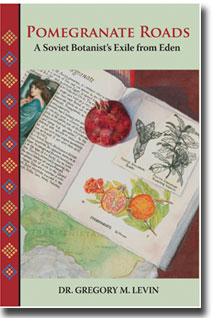
Pomegranate Roads:
A Soviet Botanist's Exile from Eden


Pomegranate Roads:
A Soviet Botantist's Exile from Eden


Dr. Gregory M. Levin

lllustrated, 216 pages
Floreant Press, 2006, $18


A few months ago, the folks at Floreant Press were kind enough to respond to what was in hindsight some pretty unbecoming hinting on my part and sent me a review copy of Pomegranate Roads.

Pomegranates (Punica granatum), despite their ancient and distinguished history, are not a fruit many people in the U.S. are terribly familiar with, nor is Turkmenistan a country that even enters the mind of the average American, except as a name on a map or a mention in a news story. Gregory Levin spent forty years researching this obscure fruit in that obscure country, and Pomegranate Roads is the story not only of those four decades, but the rest of his life as well, stretching from his childhood experiences during the German siege of Leningrad, to his retirement to Israel, where he currently resides.

Perhaps the world's foremost authority of pomegranates, Levin was based for many years at the Garrigala Agricultural Research Station in Turkmenistan, then one of the component republics of the U.S.S.R. It was here, in an isolated enclave in the mountains along the Iranian border, that he assembled a collection of 1,117 pomegranate genotypes, from ancient cultivars to unusual mutant strains (some discovered in the wild and some generated himself). The book describes his thirty years of annual expeditions to collect germplasm, journeys which would take him to twenty-seven countries,(Update: Levin's collection covered 27 countries, but Levin himself never left the U.S.S.R. on his collection trips) through wild country sometimes wracked with ethnic and political violence, gathering not only wild specimens but also cultivated types found in fields abandoned in the Soviet push towards collectivization. This unique group of pomegranates, with its dwarf trees, unusual fruit colors, rare plant habits, is perhaps Levin's greatest contribution, and it was nearly lost in 2002 when the government of the newly independent Republic of Turkmenistan ordered the destruction of his collection, converting the Garrigala station to vegetable research. Fortunately, Levin had sent cuttings from his collection to both the University of California, Davis, and Ben-Gurion University of the Negev in Israel, where many of his most important specimens are preserved today. (Over half of the U.C. collection was sent from the Garrigala station, although that repository, one of the largest in the world, is still barely 10% the size of Levin's former collection).

The book touches on nearly every aspect of the pomegranate, from its history, to its genetics, its reproduction and physiology, its role in art and literature, even to its culinary uses and purported medical properties. The history we see against a backdrop of the development of Soviet agricultural science in the era following the revolution, as well as the decline and fall with the rise of Lysenko and collectivism.

In some ways, the book is really two books, and the writing sometimes straddles them rather awkwardly. On one hand, it is a scientific text, while on the other it is an autobiography. And left to stand on their own, neither component would be as compelling. The science, while extensive, is far from exhaustive, and as the kind of person who would happily sit down and read a textbook on pomegranates, I occasionally felt frustrated to be baited with a collection of tidbits on a subject, without being provided a full picture. He rushes from topic to topic, barely pausing anywhere. (Levin has written another book, Pomegranate, which is said to be more of a scientific treatise, though I have yet to read it). Similarly, the autobiography can seem a little unfocused, sometimes resembling the meandering reminiscences of an elderly grandparent. Yet together they manage to form a compelling picture of a lifelong relationship between a man and his life's work. His deep love of his field is written clearly across each page, and by the time one reaches the end, it is possible to understand a little bit of what it is that makes a man devote his life to a plant.

Barbara Baer, an editor at Floreant Press, first heard of Levin's story through a 2001 story on public radio (The episode of Living on Earth called 'Turkmenistan Treasures' may be the one she heard--you can download it or read a transcript here) (Update: Turns out it wasn't...it was The Savvy Traveler on BBC World, but I can't find a copy of that online, so the other will have to do). She sought him out, eventually tracking him down with the help of the Israeli Embassy in Washington, D.C., and encouraged him to commit his tale to writing. We should all be grateful she did.

The book is not perfect—the writing appears to suffer somewhat in translation, and the sometimes wandering narrative can seem a little disjointed and could probably have used a little tighter editing, though I can sympathize with a reluctance to modify such an outpouring of sincere passion, and it may be that it retains a certain genuineness because of it (and really, as those who read this site probably know, I really can't criticize when it comes to editing). Still, I discovered that within only a few minutes of reading these minor difficulties faded from consciousness and I quickly found myself lost in the book.

Pomegranate Road is available directly from the publisher, as well as from Amazon and Barnes & Noble.

Update: A couple of corrections have been made to the above article. My apologies. (For the errors, not the corrections.)
Blogged with the Flock Browser

Labels: , , ,

July 12, 2008

The Murder of Nikolai Vavilov

The Washington Post has a review (or really, a historical piece inspired by a new book--the article doesn't really seem to be about the book itself) of The Murder of Nikolai Vavilov, by Peter Pringle, up online (apparently posted from the future, given that it gives July 13th as the date). I haven't read the book, but I know the basics of the story.

Vavilov isn't as well known as he should be, but his death is a symbol of a dark era in Soviet history, one whose effects were probably far greater than they are often given credit. Vavilov was a great botanist and geneticist, author of the modern theory of crop centers of origin and perhaps the greatest driving force behind a system of agricultural research which grew enormously in the early years of the Soviet era. He gathered germplasm from across the vast Soviet empire, he pushed to develop plant breeding across the country, and he studied genetics and heredity. This last would prove to be his undoing, as the rise of his rival Trofim Lysenko under Stalin strangled the study of genetics in the U.S.S.R. Lysenko took Vavilov's job, as the latter was shunned, defamed, and eventually, jailed, tortured, and killed by Stalin's secret police, and the strong foundation of research Vavilov had built was systematically dismantled in favor of Lysenko's junk science. Collections were lost, great scientists fired or killed, results suppressed, and a generation of students denied a real education in breeding. Soviet agriculture was plunged into a dark ages it has to some extent never recovered from.

Lysenko got about five minutes in my high school biology class and no time at all in history. Yet it the repeated failures of Soviet agriculture were one of the greatest stresses on the communist system, and one has to think that they contributed significantly to the eventual fall of the communist regime.

Labels: , ,

May 26, 2008

Pomegranate Roads

I found a link about this book via our friends at the Agricultural Biodiversity Weblog and thought I would pass it along.

Pomegranate Roads: A Soviet Botanist's Exile from Eden (Floreant Press)

I have a blog dedicated to fruit and science. This is a book about a fruit scientist. Do I get an offer of a review copy? No, instead I get them for dozens of cookbooks about meat. I get offers to review books every few weeks, including promotional offers and possibilities to interview authors, but there really has only been one relevant enough to review here. (And I don't feel like I can ethically accept copies of books I'm not going to review, even though some of the cookbooks look pretty cool.)

In other news, this is the 200th post on the Fruit Blog.

Labels: , , ,

April 9, 2008

Balanites...Sounds like a mineral, eats like a fruit

Actually, I'm only guessing at how it eats. I've never had it or even seen it. And I only know what I read about it in the following article:

African Fruits Could Help Alleviate Hunger and Bolster Rural Development (ScienceDaily)

One rather unfortunate legacy of colonialism (among many) is that Europeans' fruit crops to a great extent displaced the native crops in Africa and, to an extent, South America. North America's mostly held their own (strawberries, raspberries, blackberries, blueberries, cranberries, assorted are all mostly or partly North American in origin--the main fruit native to North America that hasn't hit it big that comes to mind is the Pawpaw) and were exported to the rest of the world themselves, and Asia and Europe had kind of shared a common pool of crop species for centuries. (I don't know enough about the native fruits of Australia to even comment, but I notice there aren't too many Australian species in the supermarket these days...)

The native fruits in Africa and South America are still around, for the most part, some on a small scale and some relatively common in the local market. But because they're unknown in the rest of the world, there's no great market and not that much money in them to prompt further cultivation and research.

Anyway, the linked article was prompted by the completion of the latest book in the Lost Crops of Africa series--Vol. III: Fruits. I read and enjoyed Vol. II: Vegetables, so I expect this to be a quality piece of work. And, because it's from the National Academies Press, the whole book is available online, as is the earlier Lost Crops of the Incas which has some cool info on South American species as well.

Labels: , , ,

April 21, 2007

'Educating Peter' by Lettie Teague

From time to time lately I've been getting invitations to review books, which I guess is one of the benefits of having a website that at least a handful of people read regularly. The problem is that for a long while they've all been cookbooks, and not even fruit themed ones, so they didn't seem terribly relevant.

Finally, though, I was offered a wine book, which was adequately fruit-centric for my liking: Educating Peter: How I Taught a Famous Movie Critic the Difference Between Cabernet and Merlot, or How Anybody Can Become an (Almost) Instant Wine Expert, by Lettie Teague. Ms. Teague teaches us about wine while teaching her friend, movie critic Peter Travers. They sample wines from assorted regions, cultivars, and styles, sometimes traveling to the regions themselves.

At the core, this is a perfectly adequate, even pretty good, book on wine, and for a relatively small book it's actually pretty comprehensive. But rather than livening things up and making this complex and intimidating topic more accessible and readable, the gimmick actually detracts. I generally found Peter's comments, often making strained parallels with movies and directors, to be superfluous and annoying, though he does occasionally come through with something amusing or insightful, particularly when addressing some of the more ridiculous aspects of the wine world.

My other problem with this book is that it doesn't really do what it claims to do. Contrary to the subtitle, the book hardly suggests that "anybody" can become a wine expert, nor is the process remotely instant. Peter hardly seems to me to represent the average Joe. First, he actually seems to know a fair amount about wine. Second, a movie critic, trained in the appreciation of another "art", is likely better equipped to grapple with the diversity in the art of winemaking. His training is time-consuming, world-spanning, and phenomenally expensive. After the first few chapters, I decided I was going to start tallying up the cost of the wines they taste, but my enthusiasm ran out before the end. Still, it seems like a minimum of half a dozen times per chapter they are cracking open a $45, $75, or $90+ bottle of wine, and the whole educational process is topped off with a $4,000 bottle of 1992 Screaming Eagle Cabernet (to be fair, this is given to them, not purchased as part of the Peter's education). Becoming a wine expert would be markedly easier if one had the option to taste almost any wine one liked, but that's really not a possibility most folks have.

Rather than demystifying wine, the books seems to revel in the mystique, which is a common flaw of wine books. I'm hardly an expert, by my advice on wine would be considerably more brief: Be adventurous in what you try, remember what you like, particularly the cultivar, and, most importantly, drink what you like.

On top of all that, the book sometimes cries out for an editor. The same thing is often explained repeatedly (we are told that Peter's term form tannic wines is "aggressive" over, and over again, for instance), and strange, irrelevant facts pop up here and there. For example, after learning that Beaujolais nouveau is only meant to last a season or two, Peter compares it to a summer release movie: "Nobody will want to see The 40-Year-Virgin six years after its release in August," he declared, naming the movie that stars Steve Carell that got a lot of attention on its release with the premise that the hero had never had sex until he was forty years old." How on earth is that all relevant? Is there some other movie out there named The 40-Year-Old Virgin that was a weighty classic of cinema, requiring the author to clarify which movie is being referred to? It's not horrible, it's just distracting, and kind of surprising from some one who has been a professional writer for a while. (And yes, to all my regular readers, I realize I am occasionally guilty of the same things. But I don't have an editor. And you're not paying for any of this.) (Although you're always welcome to send me money.)

Anyway, if you are a fan of either Lettie Teague or Peter Travers, you might enjoy this book, as would people with a beginning or intermediate knowledge of wine who are anxious to improve. Readers with a more advanced knowledge of wine will probably want more detail, and possibly less Peter Travers.

You can buy Educating Peter here.

Labels: , ,

November 29, 2006

How to germinate, um, anything.

This is a very impressive resource:

Handbook of Seed Technology for Genebanks - Volume II.
Compendium of Specific Germination Information and Test Recommendations (IPGRI)

This is essentially an online book, from the Interntaion Plant Genetic Resources Institute. It's aimed at curators of germplasm collections, so it's pretty technical, but there's a ton of good information there.

I find one of the most maddening experiences in horticulture is starting with a limited supply of seeds and watching in despair as they fail to germinate.

(This isn't really a fruit-specific resource, but since it covers practically everything, the fruits are all in there.)

Labels: ,

November 18, 2006

P9-15: The Lure of the Vine

I've often thought it might be nice to do book reviews here, since there's nothing that brings me joy like a good fruit book (okay, maybe there are a few other things). So far, though, the closest I've come was an earlier post on Wickson's California Fruit, which was as much about Wickson as it was the book.

A while back, I came across a book called P9-15: The Lure of the Vine, by Thomas DeWolf, on Amazon. I'm always excited to people writing things other than textbooks about plant breeding, and grapes have a special place in my heart, being the first fruit that I worked with. It outlines the history of attempts to interbreed muscadine grapes with bunch grapes, touching on the characters involved and the crosses made that led to the final product, a hybrid called P9-15. (DeWolf regards P9-15 as the pinnacle of this effort, although one of its offspring, 'Southern Home', was released as a cultivar by the University of Florida). Despite being members of the same genus, muscadines and bunch grapes do not easily interbreed, having differing chromosome numbers, and when they do the offspring are nearly always sterile. Only a handful of barely-fertile F1 hybrids have been created, such as NC 6-15 and B4-50, and these few key bridges have been the critical links to such efforts at interbreeding.

It's not a very big book, only 108 pages long, and it's not the best written work I've ever encountered. It's a little scattered and disorganized, and much of it could probably do with some serious editing, like the interview with Bob Zehnder, which is presented in it's entirety, complete with things like:
TBD: Are you having a problem hearing me?

Zehnder: Yeah.

TBD: Okay. I have you on my speakerphone. That's the reason...

It's from Hats Off Books, which I believe may be a self-publishing enterprise, and DeWolf's approach is that of a curious layman (I think he's a retired lawyer, but I couldn't find much), rather than an expert on grape breeding, so the result is a little unpolished, though his passion for the subject is obvious and endearing. Despite all the flaws, it's still well worth a read. It's full of facts, much of it material concerning old southern breeding programs or those of individuals like Bob Dunstan, Bob Zehnder, or Joseph Fennell, that would be very difficult to track down. Mostly, though, I'm excited to see some one telling this story. There are hundreds of these breeding stories, and they are part of why I love breeding and why I want to be part of it. Stories like the introduction of day-neutrality from wild strawberries, the development of primocane fruiting blackberries, self-fertile muscadines, or the Southern Highbush blueberry. Each of these represented a fundamental change in the way these fruits could be grown, and each was the result of a combination of luck, hard work, and the skills of several brilliant breeders. And each is its own exciting story, waiting to be told. DeWolf has told this one, and I'm grateful that he did.

This particular story is one that has really only begun. 'Southern Home' is the only cultivar to incorporate both muscadine and bunch grape germplasm, and it has really only succeeded as a backyard variety. It is also mostly muscadine in its background, while the real potential, I think, lies in incorporating a few key muscadine traits, particularly disease resistance, into bunch grapes. This process has only begun, but in recent years a gene for powdery mildew resistance, Run1, has been moved from muscadines into a bunch grape population and mapped, coming through the NC 6-15 hybrid (a cross of a muscadine (G52) and Vitis vinifera (a seedling of 'Malaga')).

Anyway, at $11.95 for just over a hundred pages, P9-15 probably isn't for everybody. But for those with a particular interest in grape breeding, especially in the south, and a willingness to look past the occasionally scattered presentation, it's an interesting read and a valuable resource.

Buy P9-15: The Lure of the Vine from Amazon.

Labels: , , , ,

March 22, 2005

California Fruits, by Edward Wickson

Yesterday my copy of The California Fruits and How to Grow Them, by Edward J. Wickson, finally arrived. I've seen this book cited many times over the years, but yesterday was actually the first time I had the opportunity to read it. I didn't especially set out to buy a copy, but the other night I was entertaining myself by plugging the names of old books into ABE Books' search field and came across a copy for $7, which was just too good to let go.

The book, originally published in 1889, remained the definitive text on California agriculture for many years, through repeated printings and editions (mine is the sixth edition, 1914), and is still widely cited even to this day. It presents a comprehensive picture: from the wild fruits, to colonial introductions, to cultural methods and the various species and cultivars currently under cultivation. Wickson manages to hit just about every fruit species imaginable, including a few I have never seen recieve more than a sentence in any other text. If one were a farmer getting started in California at the turn of the century, this book would have been all you needed. As a reference book for historical studies of fruit culture in that era, it is in a class with only a very few others, such as its East Coast equivalent, Ulysses Hedrick's Fruits of New York, a much larger work focused more specifically on varieties.

Wickson himself was a major player in the development of West Coast horticulture, though one much forgotten these days. Professor of Horticulture at the University of California, head of state agricultural experiment station, and later Dean of the College of Agriculture at U.C. Berkeley, Wickson was a prolific researcher and writer who laid the foundations for what has become perhaps the most productive and varied horticultural region in the world. In addition to California Fruits, Wickson also wrote the companion volume California Vegetables, several books on ornamentals, and two volumes of questions and answers about California agriculture, the first of which is available online from Project Gutenberg if you're interested.

Wickson was also a friend to many of the other prominent California horticulturists of his day, and counted among his friends both of California's foremost fruit breeders of the age, Albert Etter and Luther Burbank. Burbank, who I have mentioned previously, was the better known of the two, and remains so to this day, but Etter was known by some as "the Luther Burbank of the North Coast", and many similarities exist between the two. Both were purely self-taught and worked with a wide range of fruits. Burbank made his biggest impact with plums, while Etter is best known for his apples and strawberries (both men are worthy topics of future posts, it occurs to me). In fact, both named cultivars after their friend Wickson: Burbank the 'Wickson' Japanese plum, still occasionally grown, and Etter the 'Wickson' apple, a small, crab-like (but very sweet) apple introduced in 1944 after Wickson's death.

Wickson and Burbank eventually had a falling out of sorts. Wickson had been asked in 1910 to write the comprehensive record of Burbank's work, what would later become the monstrous twelve volume Luther Burbank, His Methods and Discoveries, their Practical Application. Burbank did not apparently place great priority on the project, and Wickson became frustrated trying to get Burbank to focus on it. By 1913 Wickson had quit. It was apparently not an easy job, because by its publication a year later, Methods and Discoveries had gone through a total of six writers. Wickson was not credited on it, and it appears by comparison of his partial draft to the completed version that there was a major shift from an academic work to something aimed at a broader audience. (If you've got $1,750 to burn, you can actually buy Wickson's draft at Barry Cassidy Rare Booksellers [scroll down] and make the comparisons yourself).

For those interested in the history of horticulture, or simply in building a horticultural library well-stocked with "the classics", California Fruits would be an important and welcome addition, likely much more affordable than other such books (and the lack of color plates means it's less likely to be taken apart). The book contains information still valuable to breeders seeking out information on pedigrees and possible new parents, and to home owners and hobbyists, for whom the less technology-dependent solutions of a century ago may be more readily applicable than today's (just lay off the lead arsenate!).

Labels: , , , ,