.comment-link {margin-left:.6em;}

Fruit Blog Header.jpg
APPLES - BRAMBLES - CITRUS - GRAPES - NUTS - PAWPAWS - PEARS - PERSIMMONS - STONE FRUITS - STRAWBERRIES - FORUM

Cherimoya
My cherimoya, shortly before it became smoothie fodder.

Archive of past images


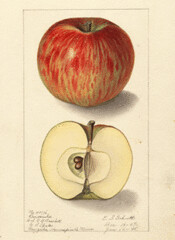
AppleBorovinka


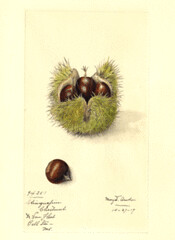
Chinquapin

Recent Cultivar Releases
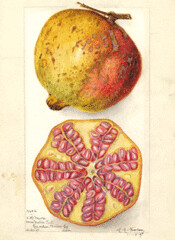
Pomegranate

Current Work in Pomology

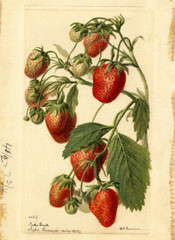
StrawbParkerEarle


QuinceBourgeat


Atom Feed

Powered by Blogger

Add to Technorati Favorites

March 6, 2010

A Life of Apples

Seems like I spend a lot of time talking about apples here, which is sort of odd, considering that I've actually never worked with them, and I talk much less about some of the crops I have worked with. But part of why apples keep coming up is that they seem to possess a special place in our culture and our history.

During my months away from this site I stumbled across an apple blog, which I read for a bit, planned on posting here, and then promptly forgot about it as work and travel took me away from the Internet. Then today I realized that the "Chris" who commented here the other day is none other than the author of that blog

A Life of Apples

A Life of Apples features a number of profiles of cultivars, all interesting and well done, which is how I found it, but also touches on the historical and mythological aspects of apples, as well as yoga, recipes, and more. A definite addition to the sidebar.

Labels: , , , ,

January 24, 2009

Bramley's Seedling Bicentennial

Happy Birthday Bramley's Seedling--200 years old in 2009 (Fruit Forum)

There's even a collection of features and events in honor of the occasion (even what they claim is the first "video pie-cast").

Labels: , ,

January 16, 2009

Charlie is my Darwin

Over on ScienceBlogs, a fellow by the name of John Whitfield has taken on the task of "blogging" Charles Darwin's On the Origin of Species:

Blogging the Origin (ScienceBlogs)

I don't especially want this site to become a debate of evolution, but regardless of your views on the subject, the Origin is still worthwhile reading, and of great relevance to the actual purpose of this site. It's a study of genetics before there really was much in the way of a field of genetics, and ultimately, it's a study of variation in living organisms--and variation is at the very core of fruit breeding. Darwin doesn't always get it his individual points right, but the man had an amazing eye for variation in nature.

(Darwin dealt more specifically with matters of domestication in a later work, and actually wrote an entire book on inbreeding, an important concept in plant breeding.)

I really like the idea of "blogging" books (Lady Evil Fruit absolutely loved Slate.com's Blogging the Bible) and I'd do it here except I'm too lazy and I don't have a particular book in mind...

Labels:

January 4, 2009

'Ohio Everbearing' black raspberry

When I first heard about the 'Explorer' primocane-fruiting black raspberry, I was convinced it was the first such variety. As it turned out, I was wrong, as numerous such cultivars existed by the turn of the century, although very few ever achieved any importance.

An exception to this, however, is the very first primocane-fruiting black raspberry, 'Ohio Everbearing'. Although not a major commercial success, this variety remains significant as one of the very first cultivated American selections of Rubus, and probably the first named black cap (given the abundance of wild black raspberries, it probably took an unusual trait such as fall-fruiting to warrant a name and cultivation).

'Ohio Everbearing' was discovered in the wild by Nicholas Longworth. Longworth was a self-made millionaire banker from Cincinnati, which in 1804 when he moved there was almost the western frontier. Although his family remained important in local and U.S. politics, and he left an estate worth $10 million when he died in 1863, Longworth's most lasting legacy is as a horticulturist. Often called "The Father of American Viticulture" (a title sometimes applied to his correspondent, John Adlum), Longworth was an avid collector and disseminator of fruit varieties. He championed first the 'Alexander' and then the 'Catawba' grapes and introduced at least one strawberry of his own creation.


Everbearing Black Caps listed in Fred Card's
Bush Fruits (1920)

American Everbearing
Cottier Everbearing
[Grigg's] Daily Bearing
Earhart
Everlasting
Every Day
Fadely
General Negley
Hixon's Everbearer
Kagy Everbearing
King of Cliff's
Lum's Autumn Black Raspberry
Lum's Yellow Canada
Miller's Daily Bearing
Munson's Everbearing
Mystery
Ransom's Everbearing
Sweet Home
Wonder
Longworth found the original 'Ohio Everbearing' somewhere in central Ohio, where he had retreated in the fall of 1832 to escape cholera outbreaks in Cincinnati. Despite it being September or October, he "found a raspberry in full bearing, a native of our state, the only everbearing raspberry I have ever met with. I introduced it the same winter into my garden, and it is now cultivated by me in preference to all others, and my table is supplied from the beginning of June to frost." Although the variety struggled somewhat on the gravelly soils of his fields, it performed better on clay soils, and Longworth was convinced it might have a future, especially in England. He sent plants there, as did A.J. Downing, though it seems have had little impact there. The legendary Dr. Hogg did note its existence in England as late as 1884, when it was probably gone in the U.S. (Incidentally, in my hypothetical strawberry-themed band, my stage name was going to be "Dr. Hogg").

Longworth was among the foremost horticultural authorities of his day, and an everbearing variety of raspberry would seem to be a major development, so it seems like it should have caught on, but while he and a few others cultivated it commercially, it never seems to have. Black caps, in general, have never attained commercial prominence, perhaps because they were foreign to European tastes, and thus unable to compete with the more familiar red raspberries. Many other everbearers, such as 'Grigg's Daily Bearing', 'Miller's Daily Bearing', and 'Lum's Autumn Black' were selected from its seedlings. (Indeed, I rather suspect most, if not all, of those everbearing black raspberries that appeared in the second half of the nineteenth century may claim it as an ancestor. Most of these seem to originate in Ohio, Kentucky, Indiana, or Illinois, the areas nearest the discovery and commercialization of Longworth's variety).

Labels: , , ,

Kid's version of the Endicott pear story...

Not real fancy, but still kind of nice. I can appreciate any attempt to get kids interested in horticulture. It held my two-year-old's attention for nearly a minute, which is about 45 seconds longer than almost anything else I've tried this afternoon.

A Tree Grows in Danvers (USDA-ARS)

Labels: , , ,

October 13, 2008

Journal of Genetics

I just discovered that just about every article ever in the Journal of Genetics is available online! (I say "just about", because they appear to have missed a couple). The Journal of Genetics was the site of some of the great early articles in fruit genetics, and by virtue of being so darn old, people rarely seem to have copies of them floating around, so the fact that they are now just a click away is pretty darn cool.

I was also interested to note that the Journal of Genetics followed editor J.B.S. Haldane (yes, that Haldane) to India when he moved there in 1957--so the journal is currently published by the Indian Academy of Sciences.

Anyway, as an example of the goodies lurking in depths of the Journal of Genetics, I present one of my favorite series of papers, by C.W. Richardson. They're favorites for two reasons. First, they were some of the first attempts at serious genetics in strawberries, a crop that is near and dear to my heart. But second, and frankly more importantly, they have some of the least informative titles ever. I always hate when I have to cite them, because I always have to actually pull out the papers and look through them, because its impossible to remember which facts go with which...

A Preliminary Note on the Genetics of Fragaria (1914)
A Further Note on the Genetics of Fragaria (1918)
Some Notes on Fragaria (1920)
Notes on Fragaria (1923)*

* This last one, unfortunately, is one of the ones they seem to have missed scanning--there's a link, but no PDF.

Update: A friend of mine found the missing paper! It's been accidentally included at the end of the previous article! (Just scroll down...)

Labels: , ,

September 2, 2008

"Breadfruit Bligh"

Those folks over at the Agricultural Biodiversity Weblog manage to dig up some good stuff:

National Tropical Botanic Garden - Breadfruit Collection

I've got to admit that breadfruits aren't a fruit I have too much experience with, and realistically most of what I could put together here is already going to be on that page, only written by people who know much, much more.

I did have a grizzled old banana worker, shy a few fingers, attempt to sell me one on a roadside outside of Cauhita, Costa Rica. I had a good time talking to him, alternating between my broken Spanish and his barely intelligible (to me) Caribbean English. What I really wanted was one of his bananas (he did eventually sell me one), but he really wanted to sell that breadfruit. He'd have sold it cheap, too, and I have to confess that I was curious, but I wasn't exactly sure what I was going to do with a raw breadfruit nearly the size of a volleyball, with no knife, no room in my bag, and at that point, not even a place to sleep. So I turned it down, assuming I'd see breadfruit again in my travels there. But I didn't.

It's hard to say what variety it was--I certainly am not an expert on breadfruit cultivars--but according to my notes at the time, of those listed on the Selected Varieties page, it most closely resembled 'White', which would at least be geographically consistent.

Which does bring up an interesting intersection of history and the breadfruit. Although many people are familiar with the story of the mutiny on the Bounty, most seem to forget the whole reason behind the H.M.S. Bounty's mission, namely to collect breadfruit trees in the Society Islands, for use as a source of high energy food for slaves in the Caribbean (you can read Bligh's orders here). (They were also supposed to pick up mangosteens to replace any breadfruit trees that died). Captain Bligh's zeal for his mission was such that his crew took to calling him "Breadfruit Bligh". The crew collected 1,015 plants in Tahiti and set off on their return voyage, but the crew had become a bit too attached to Tahiti, and three weeks later they rose up in their famous mutiny, pitched the plants overboard, and headed back to Tahiti.

You've got to give Bligh credit, though. He took the whole breadfruit thing pretty darn seriously. I like fruit—a lot, actually. But if my friends and I headed out to fetch some, say, grapes, and on the way home, my companions, say, set me adrift in an open boat for 47 days, then the next time it occurred to me that some grapes might be good, I think I might decide that, you know what, maybe I didn't need grapes after all. Not our man Bligh. A year and a half after finally making his way back to England, he set sail again, on the H.M.S. Providence, once again in search of breadfruit. This time he successfully retrieved 2,126 breadfruit trees (one of which is believed to have been the source of the 'White' cultivar in the Caribbean). He also brought back a vast collection of other plants, the names of many of which I can't even recognize. I've transcribed one such list, accompanied by my guesses as to the plants indicated. Please feel free to make suggestions! (some of this may be archaic names, some may be obscure plants):


TAHITI
BreadfruitBreadfruit (Artocarpus altilis)
RattahTahitian Chestnut (Inocarpus edulis)?
Ay'ah?
Av'vee or VeeVee Tree, ambarella, Otaheite apple (Spondias dulcis)
Oraiah"a very superior kind of plantain" (Musa paradisiaca)
Pee'ah?
Vai'hee?
Cocoa NutCoconut (Cocos nucifera)
EttowGeiger Tree (Cordia sebestena)
MatteeDye fig(Ficus tinctoria)

POSSESSION ISLAND, NEW GUINEA
Sao, or Sow"a kind of plum"

TIMOR
Breadfruit, Otaheite (Taihiti) KindBreadfruit (Artocarpus altilis)
Breadfruit, which bears feed?
MangoMango (Mangifera sp.)
IamblangJambul (Syzygium cumini)
Iambo Iremavah?
Iambo Ma'ree?
BlimbingBilimbi (Averrhoa bilimbi)
CheramailahCherimoya? If so, what's it doing in Timor?
KarambolaStarfruit, Carambola (Averrhoa carambola)
Nonefang, or Lemon ChinaLimeberry (Triphasia trifolia)
Cosambee?
NankaJackfruit (Artocarpus heterophyllus)
Namnam(Cynometra cauliflora)
PomegranatesPomegranates (Punica granatum)
Seeree boah, or Long Pepper(Piper longum?)
Seeree down?
Bintaloo?
Dangreedah?
Bugahnah KanangahYlang-ylang (Cananga odorata)
Iattee, or Tickwood?

ST. HELENA
PlantainPlantain (Musa paradisiaca)
China OrangeSweet orange (Citrus sinensis)
Dwarf PeachPeach (Prunus persica)
AlmondsAlmonds (Prunus dulcis
Nutmeg from St. Vincent'sNutmeg (Myristica sp., probably fragrans)
CoffeeCoffee (Coffea sp.)
GwavahGuava (Psidium sp.)
Poorah'owCoconut (Cocos nucifera)


An impressive collection, even in an age when trucking plant species around the planet was almost frighteningly common. Bligh established (or at least attempted to establish) these species in St. Helena, St. Vincent, and in Jamaica. While in Jamaica, he also brought back to England samples of akee, which had been previously transported to the Carribbean from West Africa, and introduced it to the scientific community. The scientific name, Blighia sapida, honors the captain.

Still, despite all this, Bligh remains best known for his mutinous crew. And, amazingly, though Bligh does not appear to have been an especially harsh captain for his time, the Bounty was not the last mutiny under his command. His crew revolted during the Spithead and Nore mutinies as well (these were large movements, and affected multiple ships and captains, though), and then, as Governor of New South Wales, he was deposed in an uprising called "the Rum Rebellion".

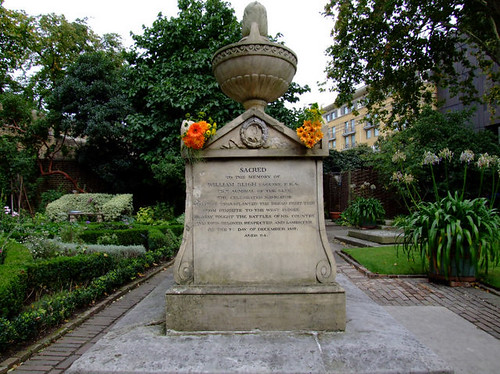
Bligh died in London in 1817, having crossed the globe several times, served on dozens of ships, and collected dozens of plant species. His tombstone lists the introduction of the breadfruit to the West Indies as one of his accomplishments, and the monument itself is crowned by a stone breadfruit.


(photos by Miranda Hodgson, used under the terms of the Creative Commons License).

Labels: , ,

August 31, 2008

Tahitian vanilla is an interspecific hybrid

It looks like the origins of Tahitian vanilla (Vanilla tahitiensis), long a mystery, have been resolved:

Tahitian Vanilla Originated in Maya Forests, Says Botanists (Science Daily)

It's not terribly shocking that the origin is Central America, given that the historical record supported the idea of going from Guatemala to Taihiti, via the Philippines. What was suprising, to me anyway, was the fact that it turns out to be an interspecific hybrid (maybe this wasn't a shocker to vanilla botanists, but my vanilla knowledge is kind of limited) between V. planifolia, the species currently cultivated for most vanilla production, and V. odorata, a species not know to have ever been cultivated. Taihitian vanilla is distinct in that it possesses the compound heliotropin, which no doubt came from the odorata parent, and gives the beans their unusually floral aroma.

The story reminds me a little of that of the cultivated strawberry, the interspecific hybrid coming into prominence far from its ancestors native lands, but of course in this case the hybridization likely occurred long before they went to Taihiti, probably in some Mayan garden. If and when the data gets published, it would be interesting to see how distant a hybrid the genetic evidence suggests this is. Given that vanilla is commonly propagated vegetatively (vanilla is an orchid, and orchids are known for being a pain to germinate, requiring the presence of specific mycorrhizal fungi), the Taihitian vanilla we grow today could conceivably be the original genotype resulting from the initial hybridization. I'd be interested to know if the odorata and planifolia chromosomes play nice and pair with each other, or if this is actually an alloploid of some kind...

(I suppose one could make a case that vanilla isn't a fruit, but I'm known for being a little flexible with my defnition around here, and it is technically the fruit that is consumed. Basically my definition is: if you eat it, and it's not an agronomic crop, and it's not a vegetable, then it's a fruit (and I've been known to be a tad flexible on the vegetable thing, too). Mostly I just thought it was a cool article.)

Update: I found the actual article, which appears to be freely available here. So there are a few answers to my questions above:
F1 hybrid?: Almost, but probably not quite
Polyploid?: Some yes (4x), some no (2x)
Single genotype: Nope.

They looked at both a nuclear region and a chloroplast region (which allows them to conclude that V. planifolia is the maternal parent in all cases).
Blogged with the Flock Browser

Labels: , , ,

July 12, 2008

The Murder of Nikolai Vavilov

The Washington Post has a review (or really, a historical piece inspired by a new book--the article doesn't really seem to be about the book itself) of The Murder of Nikolai Vavilov, by Peter Pringle, up online (apparently posted from the future, given that it gives July 13th as the date). I haven't read the book, but I know the basics of the story.

Vavilov isn't as well known as he should be, but his death is a symbol of a dark era in Soviet history, one whose effects were probably far greater than they are often given credit. Vavilov was a great botanist and geneticist, author of the modern theory of crop centers of origin and perhaps the greatest driving force behind a system of agricultural research which grew enormously in the early years of the Soviet era. He gathered germplasm from across the vast Soviet empire, he pushed to develop plant breeding across the country, and he studied genetics and heredity. This last would prove to be his undoing, as the rise of his rival Trofim Lysenko under Stalin strangled the study of genetics in the U.S.S.R. Lysenko took Vavilov's job, as the latter was shunned, defamed, and eventually, jailed, tortured, and killed by Stalin's secret police, and the strong foundation of research Vavilov had built was systematically dismantled in favor of Lysenko's junk science. Collections were lost, great scientists fired or killed, results suppressed, and a generation of students denied a real education in breeding. Soviet agriculture was plunged into a dark ages it has to some extent never recovered from.

Lysenko got about five minutes in my high school biology class and no time at all in history. Yet it the repeated failures of Soviet agriculture were one of the greatest stresses on the communist system, and one has to think that they contributed significantly to the eventual fall of the communist regime.

Labels: , ,

July 7, 2008

Saving Heirloom Apples

This is a topic I find myself talking about a lot here. Not that heirloom apples are particularly more worth saving than, say, heirloom pears, or strawberries (in fact, strawberry varieties are a lot more prone to going extinct), but mostly because people write a lot more about them.

Prince of Wales saves British apple breeds (The Telegraph)

(Doesn't it seem like I'm finding lots of articles on the Telegraph website lately?)

If you recall, not that long I go I was commending Daughter of the Soil for her act to save the 'Tewksbury Baron', and I have to say it's nice to see some rich and powerful people with more resources at their disposal taking a similar action on a grander scale (I'm less excited about all the nonsense with the Brogdale collection that led to this, but that's another story).

Of course, the Prince of Wales (who, as a child, I briefly thought might be a whale himself) is the most prominent of those preserving these, but there are others, including the Co-operative Farm at Tillington. While the idea of throwing them all together and juicing them (which apears to be their plan) seems like a tremendous waste of all that diversity, I'm glad to see some one getting some economic good out of them I suppose, and if that's enough to justify preserving them, then I'm happy to have them do whatever they want to do.

Frankly, I'd link to these article just for the apple names alone:

Bloody Ploughman

Faerie Queen

Peasgood Nonsuch

Ducksbill

Greasy Pippin

Ashmead's Kernel (yeah, I know it's better known, but it's still a cool name)

Forty Shilling*

Great Expectations*


*These last two aren't in the linked articles above, but are in yet another version, here.

Labels: , , ,

July 6, 2008

The Economics of Johnny Appleseed

I know there are plenty of people who find the intersection of genetics and fruit here to be a little unexpected and bizarre (it may be the first, but it's really not the second), but I have to admit that finding a paper on economic theory about Johnny Appleseed seems plenty of both to me.

Alertness, Local Knowledge, and Johnny Appleseed (Social Science Research Network)

Mmm...Kirznerian alterness....
Blogged with the Flock Browser

Labels: ,

July 5, 2008

It actually worked!

I could have sworn I posted when this date seed was planted, but I can't seem to find it to link to, so maybe I imagined it. Anyway, bottom line, some archaeologists found a 2,000 year old date palm seed at Masada, in Israel, planted it, and unbelievably, a couple years later, it's growing and doing fine:

Researchers Resurrect Extinct Judean Date Palm Tree from 2,000 Year Old Seed (AAAS)

The Judean date palm (a variety of Phoenix dactylifera), of which this "Methuselah" is perhaps the last remaining vestige, was once a staple crop of ancient Palestine, at one point existing in vast, towering forests along the Jordan River valley. Date palm culture declined after the arrival of Roman occupation (the Romans had a lot to do with this by preventing the Jews from propagating it), and the Judean date palm appears to have been wiped out entirely by about the sixth century A.D. Modern date palms, still a major industry in Israel, are from imported stock.

Delving into the highly reliable realm of information gathered from anonymous somebodies on internet forums that blogs so often deal in, I also found this post on PalmTalk, which references a genetic study suggesting that the plant bears little resemblance to modern palms, with only a 13% similarity to an ancient Egyptian cultivar (search for "13% similarity" or go maybe a third of the way down the page to a post by 'rubyz'). Another incredibly reliable source, Wikipedia, states that the Egyptian cultivar is Hayany, and that it is a 13% dissimilarity. Who knows. Probably it's at least kind of related to something. Still, whatever its DNA says, it's still pretty cool.

Labels: , , ,

May 30, 2008

Fruit Genetics Friday #5: The Jostaberry

Most of my "Fruit Genetics Friday" posts have really been basically genetics posts with a little gloss of fruit thrown in to tie them into the prevailing theme. So I thought for a change I'd do something very specifically fruit-focused, a little more of a story of breeding than a genetics lesson.

Currants and gooseberries are both members of the genus Ribes, a group of fruit much appreciated in Europe but unfortunately often forgotten on this side of the Atlantic. I've heard a number of reasons suggested as to why Ribes fruit haven't really become big players in the New World, despite successfully adopting nearly every other major European fruit, and having a selection of wild Ribes of our own. I could (and, quite possible, might still) write a whole post on these, but I don't want to dwell on that in what is supposed to be a genetics post. Suffice it to say that if you're American and haven't had any of the fruits mentioned in this post, you're not alone. (But you are missing out).

Given their obvious morphological similarities, the idea of crossing currants and gooseberries probably occurred almost as soon as people began developing intentional hybrid fruit. No doubt more than a few attempts were fueled by the gooseberry breeding craze which swept England in 1800's (a worthy subject for a later post).Perhaps the first was the product of a Mr. W. Culverwell, an Englishman who in 1880 produced what was called Ribes culverwelli by crossing a black currant with a gooseberry. Producing hybrid seedlings turned out not to be too terribly hard, so long as the black currant was used as the female parent.

Such crosses yielded a range of diploid progeny, with a wide range of characteristics, some resembling their currant parent, some gooseberries, many somewhere in between. Unfortunately, they all had one thing in common: they were virtually sterile. Those that did set fruit did so parthenocarpically (ie, without fertilization) and so were dead ends when it came to breeding.

The Germans made some of the most concerted efforts, and in 1926 Paul Lorenz began making crosses at Berlin's Kaiser Wilhelm Institute. By World War II he had over 1,000 F1 seedlings growing, but unfortunately in the chaos and destruction of the war, only eight plants remained. In 1946, these survivors were incorporated into a program at the newly founded Erwin Baur Institute.

It was there that Rudolf Bauer finally struck upon a method of generating fertile hybrids between black currants and gooseberries. By treating the sterile hybrids with a solution of colchicine, he was able to restore fertility.

Here I'll slip into a little more science: Colchicine is an alkaloid derived from autumn crocus (Colchium autumnale) that has been put to a variety of uses over the years. Medically, it is used to treat both cancer and gout, although it's worth noting that it's teratogenic and widly toxic, two major downsides to any medicine (though manageable with adequate care). It's value in breeding was discovered in 1937 by Albert Blakeslee, who found that plants soaked in solutions of colchicine had multiple sets of chromosomes in their cells. Turns out, colchicine inhibits spindle formation during mitosis. So basically, the chromosomes double, but the cell fails to divide, resulting in a cell with double the normal complement of chromosomes.

This is pretty useful in and of itself: polyploid plants tend to be bigger, and that often includes fruit. Lots of crop plants are polyploid (the first Fruit Genetics Friday, #1b, featured polyploidy, so I won't dwell on its many virtues here). However, from a plant breeding point of view it's greatest virtue is perhaps the ability to restore fertility in "mule" hybrids. It does this by providing chromosomes with a mate to pair with in meiosis.

For example: Imagine that a normal black currant or gooseberry has three pairs of chromosomes (they don't, they have eight, but let's keep this simple), for a total of six chromosomes. Each gamete (pollen cell or ovule) will have three, one from each pair, and these will combine to form a plant with the normal three pairs. However, the gooseberry and black currant have diverged enough evolutionarily that the chromosomes no longer recognize each other. Because of this, they don't pair normally during meiosis and can't form viable gametes. The result is a sterile plant.

So imagine the chromosomes as shown below ('c'-black currant, 'g'-gooseberry, '='-successful pairing):


Black Currant:
1c=1c
2c=2c
3c=3c


Gooseberry:
1g=1g
2g=2g
3g=3g


Diploid F1 Hyrbid:
1c 1g
2c 2g
3c 3g


The chromosomes in the hybrid don't match up, so they don't pair. Colchicine gets around this by providing each chromosome with a mate, its exact duplicate:


Tetraploid F1 Hyrbid:
1c=1c
1g=1g
2c=2c
2g=2g
3c=3c
3g=3g


Using this strategy, Bauer was able to improve the fertility of those eight survivors, and use them as the basis for further breeding. Although the collection was once again cut back severely when the institute moved to Cologne, he eventually generated 15,000 fertile tetraploid hybrid seedlings. From these he selected three hybrids, which he dubbed 'Jostaberry' as a group ("Josta" comes from the beginnings of the common names of both species in German, Johannisbeere and stachelbeere). However, there has been some confusion since then, and Jostaberry has been distributed as single clone, despite the fact that it was originally three distinct genotypes (two of which were siblings). It is not clear which of the existing clones are the original three (assuming all three survive). In addition to the original 'Jostaberry' introduction to the U.S., the Corvallis repository has two other clones, and a Swiss nursery has named two others of uncertain origin, 'Jostina' and 'Jogranda', so it's possible the originals are still out there.

The Jostaberry has much to recommend it (although it requires lots of pruning and does still suffer some residual problems with fruit set), especially in its resistance to white pine blister rust and its lack of thorns, and there has been a little subsequent interest in improving it. George Waldo, working with USDA in Oregon, did some further breeding, but there has been little activity since then, hampered by low yields and a limited market. In addition to the varieties mentioned above, the only other slections circulating are perhaps a dozen ORUS selections from the USDA, some of which are still available in nursery catalogs. Although a minor fruit today, it remains an example of what can be accomplished with a clever breeding strategy.

Labels: , , , , , , ,

Speaking of fruit trees and extinction...

Ancient pear tree to face the chop for flood scheme (Town Crier)

I'm not sure a 100 years old really counts as "ancient" (the 600 year old 'Saijo' persimmon in Oomachi, Japan is what I think of when I think of an ancient fruit tree) but it's still sad it needs to go.

Labels: , ,

May 28, 2008

North Carolina Closing Experiment Stations?

This would be very upsetting if it happens:

Legislature looks at closing Castle Hayne agricultural research facility (StarNewsOnline.com)

Actually, it's more than just the Castle Hayne station--they're talking as many as seven of the 18 stations. I can't say I'm terribly surprised, as that's a lot of experiment stations for a state its size, but it's still disappointing. Castle Hayne has been an imporant center of fruit research, particularly blueberry breeding, for a long time, and it would be sad to lose that history. Hopefully the work going on there could be relocated.

Given the large and booming blueberry industry in North Carolina, and the success of the locally developed cultivars, it would seem a shame to hamstring the breeding program (and even if they move it, breeding programs for perennials rarely come through "moves" unscathed). The North Carolina program has released dozens of cultivars, many of which are important worldwide. 'O'Neal' remains the standard in early cultivars, planted on thousands of acres around the globe, while one of their first cultivars, 'Croatan', essentially saved the industry by introducing resistance to stem canker, and still represents a substanial part of the acreage.

Here's a presentation describing the NC State blueberry releases (they throw a few non-NCSU varieties in there, which is a little misleading, though it probably was less so when presented. The asterisks in the list on the last page distinguish the actual NC releases):

An Overview of Blueberry Releases from NCSU--and Other Cultivars of Interest to NC Growers (SmallFruits.org) PDF

Labels: , , ,

May 2, 2008

Grapes Gone Wild

This link came across a mailing list that I'm on today:

Valiant Vineyards: South Dakota's first winery finding international acclaim (Prairie Business Magazine)

I have kind of mixed feelings about this idea. On one hand, I really like the idea of making use of the species native to your region, of fruit harvested from the wild. On the other hand, I've actually had Valiant Vineyard's wild grape wine, and it tastes like, well, what you'd expect wild Vitis riparia wine to taste like. Which is pretty unpleasant. It's acidic and weird, and reminds me of many of the riparia hybrids I tasted when I worked in grape breeding (although 'Frontenac', which is half wild riparia, can produce a pretty quality wine). That's just my opinion, though, and people with much more sophisticated tastes in wine than me obviously think differently.

(I do think the port might work really well, though...)

It reminds me of the 'Munson' wine I had in Arkansas. 'Munson', better known as Jaeger 70, is a hybrid of two wild vines, V. lincecumii and V. rupestris. And much like the South Dakota wine, they charge an arm and a leg for it. And much like the South Dakota wild grape wine, it tastes like wild grapes, which is to say, not particularly good, at least in the classical wine sense. (Though I will confess to a certain fondness for some wines from American grapes, many of which are only a generation or two from wildV. labrusca).

Although I don't particularly want to drink the wine, I do have a healthy appreciation of Jaeger 70, though--it's in the pedigree of virtually all French hybrid grapes, and, through these, many recent hybrids as well.

And since I'm already sort of free associating here, I might as well mention the story of Herman Jaeger. Jaeger was a Swiss immigrant who settled in Missouri in the 1860's. In addition to setting up a vineyard and winery, Jaeger also bred grapes, and was instrumental in saving the French wine industry from the phylloxera disaster in the 1870s, for which he was awarded the French Legion of Honor. ('Munson' was named for T.V. Munson, his friend and fellow grape breeder). And, in an interesting final twist, in 1895, at only 51, he walked out of his home, saying he was headed for Joplin, and was never seen again. He left behind a note instructing his family not to look for him. No one knows what became of him.

Labels: , , ,

April 28, 2008

Bananas on the Brink

This is an older article, and I feel like I linked to it before, but if so I can't seem to find it. I meant to write a bigger piece on this issue, but I just stumbled across it again, and might as well link to it, since it tells the story at least as well as I could.


Can This Fruit Be Saved? (Popular Science)


(Also, some recent news on progress against Black Sigatoka disease. Isn't "Black Sigatoka" an evil-sounding name? It sounds like a villain from a fantasy novel or something.)

Labels: , , ,

April 17, 2008

Darwin Online

Slashdot beat me to the punch on this one, so many of you may have already heard about it, but that doesn't make it any less cool: Pretty much every scrap of writing available from Charles Darwin, from his books to his notes and correspondence, is now available online:

Darwin Online

I'm particularly interested in his The Variation of Plants and Animals Under Domestication, an oft forgotten work by Darwin, but very interesting regardless. The book is full of discussions of diversity in fruits, and, in addition to the book, the archive has several other notes and articles on fruit, including this discussion of seedling fruit trees. A quick overview suggests that he was a big fan of stone fruit.

Labels:

April 10, 2008

Micah Rood, The Movie

A little Googling turned up so much Micah Rood that I can't believe I never encountered the story before. In fact, it turned up a trailer for a Micah Rood movie. Not a very good movie, would be my guess, but a movie.


I'd just like to point out that in several years of doing this I never before had a cause to post a movie on this blog, and it never really occurred to be that I ever would. (Fruit are really pretty sedentary, so the wonder of motion photography is generally kind of wasted on them.)

Labels: ,

April 9, 2008

Balanites...Sounds like a mineral, eats like a fruit

Actually, I'm only guessing at how it eats. I've never had it or even seen it. And I only know what I read about it in the following article:

African Fruits Could Help Alleviate Hunger and Bolster Rural Development (ScienceDaily)

One rather unfortunate legacy of colonialism (among many) is that Europeans' fruit crops to a great extent displaced the native crops in Africa and, to an extent, South America. North America's mostly held their own (strawberries, raspberries, blackberries, blueberries, cranberries, assorted are all mostly or partly North American in origin--the main fruit native to North America that hasn't hit it big that comes to mind is the Pawpaw) and were exported to the rest of the world themselves, and Asia and Europe had kind of shared a common pool of crop species for centuries. (I don't know enough about the native fruits of Australia to even comment, but I notice there aren't too many Australian species in the supermarket these days...)

The native fruits in Africa and South America are still around, for the most part, some on a small scale and some relatively common in the local market. But because they're unknown in the rest of the world, there's no great market and not that much money in them to prompt further cultivation and research.

Anyway, the linked article was prompted by the completion of the latest book in the Lost Crops of Africa series--Vol. III: Fruits. I read and enjoyed Vol. II: Vegetables, so I expect this to be a quality piece of work. And, because it's from the National Academies Press, the whole book is available online, as is the earlier Lost Crops of the Incas which has some cool info on South American species as well.

Labels: , , ,