Last time on Fruit Genetics Friday, I discussed the
basics of polyploidy. Polyploidy has lots of implications for fruit breeding, and some of the most profound are in terms of inheritance.
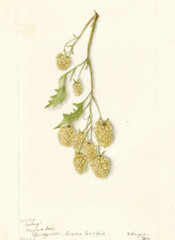
Inheritance in polyploids is different than in diploids, though the fundamental pricinpals remain the same. I'm going to assume once again that you've all got the dominant vs. recessive bit pretty much down. I'll use thornlessness in tetraploid blackberries as an example, since I've worked with it a bit. There are a couple of types of thornlessness in blackberries, but the most common is a recessive gene derived from
Rubus ulmifolius var.
inermis and passed on via 'Merton Thornless',
s. In a diploid, you might have
SS (thorny),
Ss, and
ss (thornless). In the tetraploid you get a few more genotypes:
SSSS (Thorny)
SSSs (Thorny)
SSss (Thorny)
Ssss (Thorny)
ssss (Thornless)
One thing you may notice is that it's a lot harder to see the recessive trait expressed. This can be a problem if you're breeding for a trait which is recessively inherited. The more slots to be filled, the more likely one of them is going to come up with the dominant and mask your desired trait.
Just how these four get passed on depends on what type of polyploid you're dealing with. If our tetraploid is an autoploid, we basically wind up doing the scaled version of the old familiar diploid inheritance. Instead of choosing 1 of 2 alleles from each parent, we just choose 2 of 4 instead. So if we are selfing a cultivar which is
SSss, we get:
Gametes produced (frequency):
SS (1/6)
Ss (4/6)
ss (1/6)
To the following offspring (frequency):
SSSS =
SS &
SS (1/6 x 1/6 =
1/36) (Thorny)
SSSs =
SS &
Ss or
Ss &
SS (1/6 x 4/6 + 4/6 x 1/6 =
8/36) (Thorny)
SSss =
SS &
ss or
ss &
SS or
Ss &
Ss (1/6 x 1/6 + 1/6 x 1/6 + 4/6 x 4/6 =
18/36) (Thorny)
Ssss =
SS &
Ss or
Ss &
SS (1/6 x 4/6 + 4/6 x 1/6 =
8/36) (Thorny)
ssss =
ss &
ss (1/6 x 1/6 =
1/36) (Thornless)
So, as I noted before, even if your parents have half their alleles the recessive, only 1 in 36 of the offspring will show the trait (compare this to 1 in 4 for a comparable situation in a diploid). These ratios also assume random chromosome assortment. Random chromosome assortment is considered a given in diploids, and more or less most of the time it is in autoploids, as well, but one consequence of having multiple possible partners for each chromosome is that sometimes the fact that they can form configurations other than simple pairs leads to complications, particularly something called random
chromatid assortment. I won't go into the details here because it's a mess, but suffice it to say, weird things happen, including getting progeny with genotypes impossible under normal assumptions (such as
SSSs x
SSSs yielding some offspring with
ssss, for example).
The situation is different with an alloploid. If you recall, alloploids have distinct sets of chromosomes from differing origins (in this case we'll call them A and B). These sets are going to pair with each other, so you get regular pairing like in a diploid, effectively giving you the equivalent of two genes with two copies each, rather than four copies of a single gene. In some ways this simplifies things, but it also adds a few twists. For example, not all
SSss individuals will pass on the trait the same way, because it matters which genomes the alleles are in. If both genomes have one copy of either allele (we'll express it [
Ss][
Ss], with the first pair of brackets the A genome, the second the B), then we see something like this:
Gametes produced (frequency):
SS [
S][
S] (1/4)
Ss [
S][
s] (1/4)
sS [
s][
S] (1/4)
ss [
s][
s] (1/4)
You might have noticed that it'd be much easier to find a ssss seedling in this case, 1 in 16. However, another
SSss individual may have its genes configured differently. If both copies of the recessive are in one genome and both copies of the dominant in the other ([
SS][
ss], we see something more like this:
Gametes produced (frequency):
Ss [
S][
s] (all)
See what's happening? The A genome is [
SS], so it can only contribute an
S to a gamete. The B genome is [
ss], so it can only contribute an s. Thus all gametes will be the same, and in fact, all selfings will result in the same genotype, in this case
SSss ([
SS][
ss]), the same as the parent. So it would be impossible to find any thornless plants at all, no matter how many seedlings you grew out from the selfing.
To add yet another wrinkle to this, in higher order polyploids, you can have segmental alloploids, where portions of the genome behave like autoploids within an alloploid. So one could have a hexaploid [
SSss][
Ss], for example, in which the A genome exhibits inheritance like an autotetraploid, and the B genome behaves like a diploid. Crazy stuff.
The big lesson here is, of course, polyploids are darn complex (which is why the inheritance of many important traits, even in well-studied polyploid species, is still unknown except in vague terms). In fact, they are complex enough that I'm thinking this probably wasn't a wise topic to tackle, particularly early in this series, but I promised it, so there it is. Enterntained me to write it, anyway. Feel free to ask questions, and I'll do what I can to explain.
"Next Week" on Fruit Genetics Friday: Self-Incompatibility. Why do some fruit crops require a second variety to pollinate, and why do some pollen source work better than others?
I'm willing to entertain requests, too, by the way...I don't have any kind of master plan for this series, besides a vague hope to make it quasi-regular in its timing, and I've always gotten great article suggestions from my readers in the past (some of which I've followed through on, and some of which have fallen through the cracks.)
Labels: blackberry, brambles, Fruit Genetics Friday, genetics, Rubus





 (Janick & Moore)
 (Janick & Moore)
 (USDA)
 (Deppe)
 (Pollan)
 (Hancock)
 (Ray)
(Ray)
 (Gollner)
 (Jackson)
 (Reich)
 (Bowling)
 (Trehane)
 (Singh)
 (Stuppy & Kesseler)
 (Staub)
 (Gordon)
 (Boning)
 (Juniper)
 (Yepsen)
 (Stilphen)
 (Koeppel)
 (Chapman)
 (Gough)
 (Gough)
 (Barney & Hummer)
 (Lazslo)
 (McGovern)
 (DeWolf)
 (Sullivan)
 (Munson)
 (Brantley)
 (Freinkel)
 (Taylor)
 (Train)
 (Levin)
 (Levin)
 (Kleinberg)
 (Darrow)
 (Hancock)
 (Maas, ed.)
 (Ashton)
 (Smith)
 (Pringle)
 (Campbell)
 (Sharma)
 (Musselman)