



Aunt Rosie's Old Fashioned Rubus x loganobaccus
A recent discussion regarding fruit drinks revealed two facts to me:
A.) Aunt Rosie's Loganberry drink is a regional thing. Apparently it's available only in western New York, where I grew up. It joins things like Genesee beer on the list of things I assumed everyone had heard of that earn me weird looks now that I live a thousand miles a way.
B.) Nobody has a clue what a loganberry is. Well, people have a clue, in that a couple people suggested it was "like a raspberry". Considering there is some one in my lab who didn't know pickles were made from cucumbers, that's actually really pretty darn close.
It's not really that big a surprise that most people here haven't seen them...they aren't widely grown in the east, though most people have heard of them. Even where they are grown, they aren't especially well liked by many producers, as the fruit doesn't harvest very cleanly (more on this later), is frequently obscured by leaves, and ripens unevenly. Productivity is not especially high. Still, there's a market for them, and fair numbers (mostly produced in the Pacific Northwest, like all brambles in this country) are produced, mostly for drinks and jam. The plant is vigorous, sprawling, and thorny (though there are thornless forms).
The origins of the 'Loganberry' are still shrouded in mystery, and every time I think I've heard the last word on it I see something new suggesting something different. But here are the facts as they are known (to me, at any rate):
In 1881, near Santa Cruz, California, Judge James Harvey Logan decided to take a stab at blackberry breeding. In his garden grew a California dewberry, Rubus ursinus, called 'Aughinbaugh'. Dewberries require pollination from an outside source, and Logan assumed that source would be the 'Texas Early' blackberry he had growing nearby. He collected seeds and grew out about a hundred seedlings.
Two of these seedlings attracted his attention. One was a truly enormous beast of a plant, with a berries two and half inches long (Logan reported that this original plant produced 149 feet of fruiting canes, and covered a wall 40 feet long and 6 feet high with foliage). It was clearly a blackberry, presumably a hybrid of Rubus ursinus x 'Texas Early', and he named it 'Mammoth'. (A photo of 'Mammoth', from E.J. Wickson's California Fruits appeared as the Image of the Day a while back...see it in the archives here.)
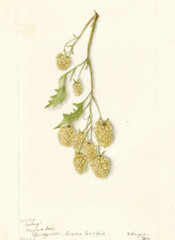
The other was an even more unusual plant. Although the plant was similar to the wild blackberry, the fruit were strikingly different. They started a bright red, darkening to a dull purple when ripe, and had surfaces more like raspberries than blackberries, but the torus (the central core of the fruit) was more tightly attached to the fruit, though not so much as the blackberry. (The rule of thumb in determining whether a bramble is a blackberry or raspberry is the type of fruit detachment: raspberries leave the torus attached to the plant, leaving hollow fruit, while blackberries retain the core. Hybrids between the two frequently split the difference, which doesn't work especially well.) It was self-fertile, disease and insect resistant, and, by the standards of the day, quite productive.
Logan concluded that a little pollen from a third plant had snuck in, probably the raspberry he had growing on the other side of the dewberry. Although I've generally heard this referred to as 'Red Antwerp', an old cultivar, possibly of English origin, Logan himself explicitly states in his Memoirs: "The raspberry referred to has been growing in this place for the last forty years, and; I am unable to ascertain what variety it is, although it is of a type similar to the Red Antwerp. It is not, however, the Red Antwerp as we have been growing it here." So who knows for sure what it actually was. Fuller's Small Fruit Culturist, a contemporary reference book, lists an 'Antwerp Red' (aka True Red Antwerp, Old Red Antwerp, Knevett's Antwerp, Howland's Antwerp, Burley's Antwerp, and English Antwerp), an 'Antwerp' (aka Hudson River Antwerp or New Red Antwerp), and an 'Allen's Antwerp', 'Barnet's Antwerp' and several others described as "very similar to the Antwerp", so it's hard to say just what had made it's way across the continent labeled 'Red Antwerp'.
Regardless, the 'Loganberry' caught on, making its way to Europe by 1897 and displacing most other blackberries in southern California. Still, debate raged about just where the 'Loganberry' came from. It had surprisingly regular reproductive behavior for a wide interspecific hybrid: it was fully fertile and bore progeny very similar to itself. without segregation for blackberry and raspberry characters. Cytogenetic work indicates regular chromosome pair behavior, consistent with a true species, rather than a hybrid. These led many botanists (including some current ones) to consider it a red fruited subspecies of Rubus ursinus, most prominently George Darrow, though he eventually reversed his judgement decades later. Subsequent experiments have borne this out in my opinion, though there are diehards who still support the blackberry hypothesis.
In 1933, a thornless mutation of 'Loganberry' was found, making it one of the earlier thornless cultivars available. While this was a notable improvement, it had one major fault, in that it did not come true from root cuttings or suckers, nor was the thornless trait transmitted to its offspring. The mutation in 'Thornless Loganberry' turns out to be present only in the outer layer of cells, and when tissue originated from other layers (such as the roots or reproductive tissues) it lacked the mutant gene. In 1986, however, this problem was solved when researchers managed to generate a pure thornless loganberry they called 'Lincoln Loganberry', by using tissue culture. (The same folks also solved a similar problem with the blackberry 'Thornless Evergreen'.) Another lab in Italy also produced similar thornless loganberries. The thornlessness gene seems to be dominant, which may prove useful now that it can be sued for breeding (the most common source of thornlessness in blackberries is a recessive trait).
Logan's successes with the 'Loganberry' and 'Mammoth' blackberry helped touch off a nationwide interest in hybridization, particularly among the small fruits. Its introduction was followed by a number of California hybrid berries: 'Boysenberry' (a cross of Loganberry by a wild dewberry), 'Phenomenal' (another blackberry/raspberry hybrid, introduced by Luther Burbank), 'Youngberry' ('Phenomenal' x 'Austin Mayes'), and 'Olallieberry' ('Loganberry' x 'Youngberry'). Many of these have now replaced the 'Loganberry', but it remains the best known of the hybrid brambles. So while the 'Loganberry' itself has become something of a rarity, its progeny remain with us.
Now if I could just find some Aunt Rosie's.
(Not that it's particularly incredible, but thinking about it has left me with a powerful nostalgic longing for it.)
Labels: brambles, loganberry, Rubus
posted by Evil Fruit Lord @ 1:25 AM
16 comments



 (Janick & Moore)
 (Janick & Moore)
 (USDA)
 (Deppe)
 (Pollan)
 (Hancock)
 (Ray)
(Ray)
 (Gollner)
 (Jackson)
 (Reich)
 (Bowling)
 (Trehane)
 (Singh)
 (Stuppy & Kesseler)
 (Staub)
 (Gordon)
 (Boning)
 (Juniper)
 (Yepsen)
 (Stilphen)
 (Koeppel)
 (Chapman)
 (Gough)
 (Gough)
 (Barney & Hummer)
 (Lazslo)
 (McGovern)
 (DeWolf)
 (Sullivan)
 (Munson)
 (Brantley)
 (Freinkel)
 (Taylor)
 (Train)
 (Levin)
 (Levin)
 (Kleinberg)
 (Darrow)
 (Hancock)
 (Maas, ed.)
 (Ashton)
 (Smith)
 (Pringle)
 (Campbell)
 (Sharma)
 (Musselman)