Those folks over at the
Agricultural Biodiversity Weblog manage to dig up some good stuff:
National Tropical Botanic Garden - Breadfruit CollectionI've got to admit that breadfruits aren't a fruit I have too much experience with, and realistically most of what I could put together here is already going to be on that page, only written by people who know much, much more.
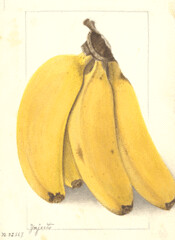
I did have a grizzled old banana worker, shy a few fingers, attempt to sell me one on a roadside outside of Cauhita, Costa Rica. I had a good time talking to him, alternating between my broken Spanish and his barely intelligible (to me) Caribbean English. What I really wanted was one of his bananas (he did eventually sell me one), but he really wanted to sell that breadfruit. He'd have sold it cheap, too, and I have to confess that I was curious, but I wasn't exactly sure what I was going to do with a raw breadfruit nearly the size of a volleyball, with no knife, no room in my bag, and at that point, not even a place to sleep. So I turned it down, assuming I'd see breadfruit again in my travels there. But I didn't.
It's hard to say what variety it was--I certainly am not an expert on breadfruit cultivars--but according to my notes at the time, of those listed on the
Selected Varieties page, it most closely resembled
'White', which would at least be geographically consistent.
Which does bring up an interesting intersection of history and the breadfruit. Although many people are familiar with the story of the mutiny on the
Bounty, most seem to forget the whole reason behind the
H.M.S. Bounty's mission, namely to collect breadfruit trees in the Society Islands, for use as a source of high energy food for slaves in the Caribbean (you can read Bligh's orders
here). (They were also supposed to pick up mangosteens to replace any breadfruit trees that died). Captain Bligh's zeal for his mission was such that his crew took to calling him "Breadfruit Bligh". The crew collected 1,015 plants in Tahiti and set off on their return voyage, but the crew had become a bit too attached to Tahiti, and three weeks later they rose up in their famous mutiny, pitched the plants overboard, and headed back to Tahiti.
You've got to give Bligh credit, though. He took the whole breadfruit thing pretty darn seriously. I like fruit—a lot, actually. But if my friends and I headed out to fetch some, say, grapes, and on the way home, my companions, say, set me adrift in an open boat for 47 days, then the next time it occurred to me that some grapes might be good, I think I might decide that, you know what, maybe I didn't need grapes after all. Not our man Bligh. A year and a half after finally making his way back to England, he set sail again, on the
H.M.S. Providence, once again in search of breadfruit. This time he successfully retrieved 2,126 breadfruit trees (one of which is believed to have been the source of the 'White' cultivar in the Caribbean). He also brought back a vast collection of other plants, the names of many of which I can't even recognize. I've transcribed one such list, accompanied by my guesses as to the plants indicated. Please feel free to make suggestions! (some of this may be archaic names, some may be obscure plants):
| TAHITI |
| Breadfruit | Breadfruit (Artocarpus altilis) |
| Rattah | Tahitian Chestnut (Inocarpus edulis)? |
| Ay'ah | ? |
| Av'vee or Vee | Vee Tree, ambarella, Otaheite apple (Spondias dulcis) |
| Oraiah | "a very superior kind of plantain" (Musa paradisiaca) |
| Pee'ah | ? |
| Vai'hee | ? |
| Cocoa Nut | Coconut (Cocos nucifera) |
| Ettow | Geiger Tree (Cordia sebestena) |
| Mattee | Dye fig(Ficus tinctoria) |
|
| POSSESSION ISLAND, NEW GUINEA |
| Sao, or Sow | "a kind of plum" |
|
| TIMOR |
| Breadfruit, Otaheite (Taihiti) Kind | Breadfruit (Artocarpus altilis) |
| Breadfruit, which bears feed | ? |
| Mango | Mango (Mangifera sp.) |
| Iamblang | Jambul (Syzygium cumini) |
| Iambo Iremavah | ? |
| Iambo Ma'ree | ? |
| Blimbing | Bilimbi (Averrhoa bilimbi) |
| Cheramailah | Cherimoya? If so, what's it doing in Timor? |
| Karambola | Starfruit, Carambola (Averrhoa carambola) |
| Nonefang, or Lemon China | Limeberry (Triphasia trifolia) |
| Cosambee | ? |
| Nanka | Jackfruit (Artocarpus heterophyllus) |
| Namnam | (Cynometra cauliflora) |
| Pomegranates | Pomegranates (Punica granatum) |
| Seeree boah, or Long Pepper | (Piper longum?) |
| Seeree down | ? |
| Bintaloo | ? |
| Dangreedah | ? |
| Bugahnah Kanangah | Ylang-ylang (Cananga odorata) |
| Iattee, or Tickwood | ? |
|
| ST. HELENA |
| Plantain | Plantain (Musa paradisiaca) |
| China Orange | Sweet orange (Citrus sinensis) |
| Dwarf Peach | Peach (Prunus persica) |
| Almonds | Almonds (Prunus dulcis |
| Nutmeg from St. Vincent's | Nutmeg (Myristica sp., probably fragrans) |
| Coffee | Coffee (Coffea sp.) |
| Gwavah | Guava (Psidium sp.) |
| Poorah'ow | Coconut (Cocos nucifera) |
An impressive collection, even in an age when trucking plant species around the planet was almost frighteningly common. Bligh established (or at least attempted to establish) these species in St. Helena, St. Vincent, and in Jamaica. While in Jamaica, he also brought back to England samples of akee, which had been previously transported to the Carribbean from West Africa, and introduced it to the scientific community. The scientific name,
Blighia sapida, honors the captain.
Still, despite all this, Bligh remains best known for his mutinous crew. And, amazingly, though Bligh does not appear to have been an especially harsh captain for his time, the
Bounty was not the last mutiny under his command. His crew revolted during the Spithead and Nore mutinies as well (these were large movements, and affected multiple ships and captains, though), and then, as Governor of New South Wales, he was deposed in an uprising called "the Rum Rebellion".
Bligh died in London in 1817, having crossed the globe several times, served on dozens of ships, and collected dozens of plant species. His tombstone lists the introduction of the breadfruit to the West Indies as one of his accomplishments, and the monument itself is crowned by a stone breadfruit.

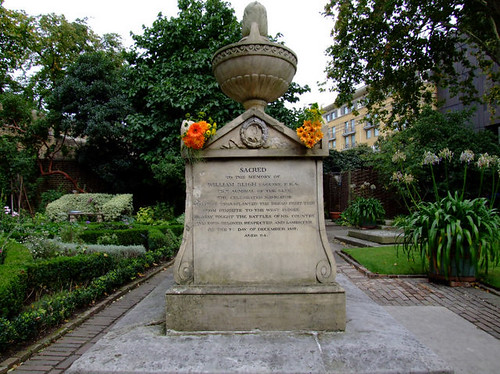 (photos by Miranda Hodgson, used under the terms of the Creative Commons License).
Labels: artocarpus, breadfruit, history





 (Janick & Moore)
 (Janick & Moore)
 (USDA)
 (Deppe)
 (Pollan)
 (Hancock)
 (Ray)
(Ray)
 (Gollner)
 (Jackson)
 (Reich)
 (Bowling)
 (Trehane)
 (Singh)
 (Stuppy & Kesseler)
 (Staub)
 (Gordon)
 (Boning)
 (Juniper)
 (Yepsen)
 (Stilphen)
 (Koeppel)
 (Chapman)
 (Gough)
 (Gough)
 (Barney & Hummer)
 (Lazslo)
 (McGovern)
 (DeWolf)
 (Sullivan)
 (Munson)
 (Brantley)
 (Freinkel)
 (Taylor)
 (Train)
 (Levin)
 (Levin)
 (Kleinberg)
 (Darrow)
 (Hancock)
 (Maas, ed.)
 (Ashton)
 (Smith)
 (Pringle)
 (Campbell)
 (Sharma)
 (Musselman)