I said I'd be back, and, lo and behold, here I am.
I thought I'd start off with a post on the cherimoya, since Suebob mentioned it on
Snackish the other day (this way I know at least one person is interested). Cherimoyas are native to the northern Andes of South America and were cultivated by the Inca and their predecessors in the region, who spread it to Chile, Argentina, and Brazil (pottery vessels shaped like the fruit have been found among grave goods, though some claim they are actually soursops,
Annona muricata). The name has been said to be from the Quechua words for "cold breast of woman", a translation which can be traced to Vicuña Mackenna, in 1875. Given that it the fruit is covered with oblong, scale-like structures, it strikes me as a pretty freaky-looking breast and I have to wonder about this interpretation, especially since literally 'cheri' means 'cold' and 'moya' can mean 'seed' or 'rounded'.
Cherimoya belongs to the family Annonaceae, the custard-apples, a group it shares with the
pawpaw. It is probably the best known member of the fairly diverse genus
Annona.
Annona cherimola is a small, spreading tree with a mature height of around eight meters and large, pubescent leaves. The fruit are heart-shaped with an irregular surface covered with a thin green skin, which turns blackish when ripe. The insides of the seeds are poisonous, and while they're fairly likely to pass straight through your system intact, I wouldn't really recommend swallowing them, particularly not in any quantity. The skin would probably make one rather unhappy, too, so leave that alone and just enjoy the soft, custardy flesh (the seeds are interspersed liberally throughout, so working around them all is no small task, though definitely worth the effort). According to Snackish, Mark Twain once said the cherimoya was "like deliciousness itself", and while I couldn't find a reference, it is certainly deserving of such praise.
The cherimoya follows its cousin the pawpaw's lead by being a big pain when it comes to pollination. Like the pawpaw, the flowers are not especially attractive to bees and other insect pollinators (although certain fruit beetles may pollinate them under natural conditions). The flowers are hermaphroditic, which is usually a good recipe for self-pollination, but in the cherimoya this is prevented by the fact that the male and female parts of the flower mature at different times. The flower slightly opens in the morning and the stigmas (the female parts) are exposed. It remains in this female phase for the rest of that day and through the next until sometime in late afternoon or early evening, when the stigmas dry out and become mostly infertile (though some may remain slightly receptive) Bees sometimes pick up pollen but are unable to enter the partially opened flower during the female phase. At this point the petals of the flower spread fully, exposing the anthers (the male organs) which begin to shed pollen. (This sort of set up is called 'protogyny', for those of you who collect obscure botany terms (or are actually botanists)). While some self-pollination can occur, the resulting fruit are usually misshapen and commercial producers usually turn to hand-pollination, which has the added benefit of allowing precise control of crop load, although it has the side effect of making them a rather expensive. Hormone sprays have been shown to induce fruit set in cherimoya, but they need to be applied several times, and have not proven much of a success commercially.
Large scale commercial production takes place in Chile (where it is considered the "national fruit"), as well as Bolivia and Argentina. It is also produced in the highlands of Brazil, Mexico, and Central America, where it has become naturalized in places, and in Australia, Israel, and the Portuguese island of Madeira. Small scale industry exists in places around the Mediterranean Basin and in India, Sri Lanka, the Philippines, and the Canary Islands. There is very little grown in the United States: Perhaps a hundred acres maximum in California, a little in Hawai'i and Florida. The trees are completely intolerant of frost, and so there are really very few places in the country capable of sustaining them.
There are quite a few cultivars of cherimoya, though many of them are quite poorly documented and may in fact by a mixture of genotypes. In the Peru, the varieties are named according to the surface characteristics of the fruit: 'Lisa', almost smooth skinned; 'Impresa', with fingertip like impressions; 'Umbonada', with rounded bumps; 'Papilonado' with fleshy protrusions; and the appetizingly named 'Tuberculada', which features large conic protrusions tipped by warty structures. Breeding has been conducted in Peru, Chile, and Columbia, as well as in Florida and California, where a number of cultivars have been introduced, notably 'Booth', 'Dr. White', and 'Chaffey'. Some California growers are also cultivating 'Selma', a pink-fleshed genotype.
In 1908, P.J. Wester, a scientist at the U.S.D.A. lab in Miami (which strikes me as a nightmarish place to have to live in that era), made a cross between the cherimoya and its cousin,
Annona squamosa, the sugar apple. Wester took the seeds to the Philippines (then an American possession), where a number of them grew into mature trees. He named it 'atemoya', from 'ate', an old Mexican term for the sugar apple, and 'cherimoya'. Nine of these seedlings were sent back to the USDA by Wester. A few years later he also introduced a seedling of one of these nine pollinated by a custard apple, #39809, under the name 'cuatemoya' (and apparently entirely forgotten, as I can't find much reference to it). A handful of other hybrids, mostly of chance origin, are also considered atemoyas. All have toxic seeds.
The atemoya is slightly hardier than the cherimoya, and a handful of commercial producers exist in Hawai'i and Florida, where it occasionally appears in grocery stores and specialty markets. The fruit and plant are quite similar to the cherimoya, and the flowers have similar issues with pollination. Cultivars include 'Page', one of the oldest cultivars, 'African Queen', a South African introduction, and a number of Israeli hybrids, including 'Geffner', which have been tested at the USDA station in Miami. A few cultivars from Egypt are also available, namely 'Cherimata' and 'Finny'. This last is a productive, well-established cultivar in Egypt, and may be well suited for coastal regions.
In the interest of completing the lineup of "oyas", I'll also mention the soncoya,
Annona purpurea. Also sometimes called 'ilama' (this name is also applied to
Annona diversifolia) and a host of other local names, it is a native of the coastal lowlands of Mexico, Central America, Colombia and Venezuela. The fruit, while structurally similar to the cherimoya, is covered with a fuzzy brown skin, and has a aromatic, somewhat fibrous, yellow flesh. It is consumed locally and may appear in regional markets from time to time, but is not an especially preferred crop (in Guatemala and Costa Rica many natives consider it unfit for consumption). I didn't find any references to the seeds as being poisonous, like the other "oyas", but they do seem to kill fleas, based on which I think I'm going to recommend you avoid them anyway.
Sadly, none of these species show up routinely in most grocery stores (though your odds may be better in southern California). You can, however, get cherimoya via mail order from
Calimoya.
Update: Less than 12 hours later and I've had a comment and an e-mail which suggest that cherimoyas do show up frequently where they live (which is nowhere near California). So I stand corrected. More accurately, these things don't show up routinely in any grocery store I have visited regularly over the past decade or so. They're pretty perishable, so stocking them in, say, Chicago, probably incurs a substantial expense. But it may be that in decent size metropolitan areas your odds are pretty good. Or maybe they're all over the place, and there's just a little anti-cherimoya zone that follows me around the country. Makes me want to go cherimoya hunting when I'm down in Tampa tonight.
Labels: Annona, cherimoya


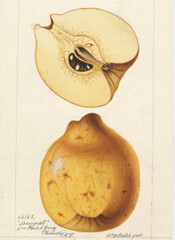


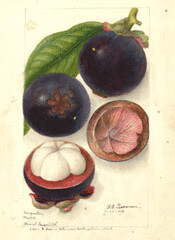
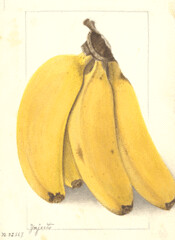

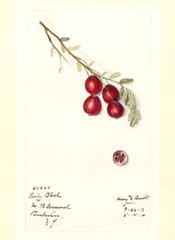
 (Janick & Moore)
 (Janick & Moore)
 (USDA)
 (Deppe)
 (Pollan)
 (Hancock)
 (Ray)
(Ray)
 (Gollner)
 (Jackson)
 (Reich)
 (Bowling)
 (Trehane)
 (Singh)
 (Stuppy & Kesseler)
 (Staub)
 (Gordon)
 (Boning)
 (Juniper)
 (Yepsen)
 (Stilphen)
 (Koeppel)
 (Chapman)
 (Gough)
 (Gough)
 (Barney & Hummer)
 (Lazslo)
 (McGovern)
 (DeWolf)
 (Sullivan)
 (Munson)
 (Brantley)
 (Freinkel)
 (Taylor)
 (Train)
 (Levin)
 (Levin)
 (Kleinberg)
 (Darrow)
 (Hancock)
 (Maas, ed.)
 (Ashton)
 (Smith)
 (Pringle)
 (Campbell)
 (Sharma)
 (Musselman)