.comment-link {margin-left:.6em;}

Fruit Blog Header.jpg
APPLES - BRAMBLES - CITRUS - GRAPES - NUTS - PAWPAWS - PEARS - PERSIMMONS - STONE FRUITS - STRAWBERRIES - FORUM

Cherimoya
My cherimoya, shortly before it became smoothie fodder.

Archive of past images


AppleBorovinka


Chinquapin

Recent Cultivar Releases
Pomegranate

Current Work in Pomology

StrawbParkerEarle


QuinceBourgeat


Atom Feed

Powered by Blogger

Add to Technorati Favorites

August 22, 2009

Smoothie Quest

As much as I like to occasionally gripe about the selection of fruit in grocery stores, I have to say the number of interesting fruits in them has certainly improved in the last decade. My three year-old and I decided at dinner we were going to make smoothies tonight. We already had blueberries at home, and I had half a flat of strawberries from work in the car (I was planning an informal tasting of the five leading selections, which was cut short when one of my daughters wolfed down one clamshell's worth in a matter of seconds). So we headed to the store and went fruit shopping.

She made her old dad proud, choosing a really eclectic mix of fruits, each of which I sampled before dropping them into the mix:

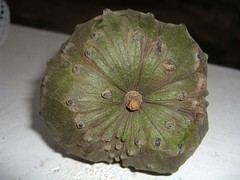
Cherimoya:
Cherimoya Cherimoya


Wow...I'd forgotten how much I liked cherimoya. The aroma is wonderful. And it worked really well in a smoothie. The only downside was digging out all those seeds (which are hopefully working on germinating right now...)

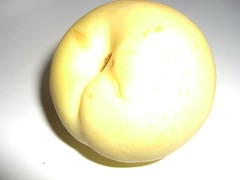
Honeydew Nectarine:
Honeydew nectarine


I had never heard of this before...and I really wasn't missing much. It tasted like a blend of really bland nectarine and underripe melon. It might not have been fully ripe, but the texture suggests it was close. Still, a pale yellow nectarine is interesting. (My picture is kind of washed out...oh well.

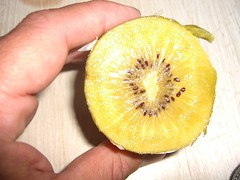
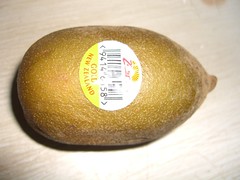
Golden Kiwi:
Gold Kiwi Gold Kiwi


I've been seeing these for a while, but this is actually the first time I've bought one. Interesting that the shape and skin are so distinctive--if I had to guess, this is Actinidia chinensis, not the usual Actinidia deliciosa. It was pretty good, but nothing spectacular. It was a tad past its peak, I think, but it went into the mix just fine.

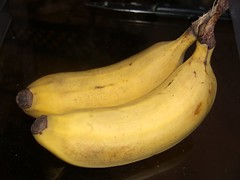
Manzano Bananas:
Manzano Bananas


I really like these things. I probably should have waited for them to darken more (it does improve the flavor), but they're really good even at this stage. I ate one while I worked and gave the other to my daughter, so none made it in the smoothie (we bought some standard bananas too, which served just fine).

We also got blackberries (which my daughter had nearly reduced to smoothies already by the time we got them back to the car--she was enjoying shaking the bag vigorously), a nectarine, more standard versions of kiwi and banana, and an apple.

The smoothies were good and we got to discuss lots of different fruit species. How many three year olds do you know who can tell you all about cherimoyas?

(I didn't really have a point to this post, other than just basking in all the fruit I just bought).

Labels: , , , , , , ,

August 9, 2008

Kiwis on the extremes

In the comments on a recent message, Brandon mentions wanting to grow kiwis in Florida. Most commercial kiwis are 'Hayward'--but 'Hayward' requires roughly 800 hours of chilling (time between 32° and 45°F). That's probably nearly twice what Gainesville (where he is) is getting.

There are many low-chill varieties, though. All of the following are described as requiring 250 or less chill hours:

Vincent—Produces large crops of smallish brown fruit
Dexter—An Australian variety, medium in size, slightly elongated, quite hairy
Abbott—Small to medium, oval, dark brown, long, dense hairs
Allison—Similar to 'Abbott'
Elmwood—Extremely vigorous, produces large kiwi-shaped fruits.
Bruno—Large, long, cylindrical, dark brown, with short, dense hairs. Light green flesh, good flavor.
Monty—Small to medium fruit, large yields, very late
Tewi—A lower chill seedling of 'Hayward', which it resembles.
Blake—Early maturing, low-chill, and teardrop shaped (supposedly, though I have to say some of the pictures I've seen don't really look it).

Since kiwis require pollination, you'll need to find low chill male, too. Some nurseries will just sell home growers male seedlings, but that's a little risky, because you never know what you might be getting--there's always a chance it won't bloom at the right time, or be horribly disease sensitive, or, in the case of Florida, be too high chill to bloom properly at all. It's probably worth the investment to get a named male cultivar. 'Matua' is that one I most commonly see mentioned for low-chill areas, but Chico No. 3 may work better for really early females.

On the other end of the spectrum is the hardy kiwi (Actinidia arguta) and the "arctic" or "superhardy" kiwi (Actinidia kolomikta). These species can grow in places too cold for the typical kiwis, surviving temperatures down to -25°F, in the case of A. arguta, and -40°F with A. kolomikta. Hardy doesn't necessarily mean winter-proof: hardy kiwis can easily be fooled into breaking bud early, and are sometimes victims of spring frosts.

The fruit isn't what we usually think of as a kiwifruit--a bit more like a grape than a big fuzzy egg, but the flavors are fairly similar, and with relatively thin, fuzz-less skins, you can pop them in your mouth without peeling. Since they don't fit the standard kiwi mold, there have been attempts to market A. arguta under a range of other names: piwifruit, bowervine, tara, yang-tao; but none of these seem to stick.

Some A. arguta cultivars include:
Ananasnaya—A Russian variety whose name means "pineapple-like". (Because hardly anyone who isn't Russian can say the name on the first try, some nurseries call this 'Anna', which is easier to deal with but nowhere near as exotic sounding. Probably the most common variety, it's flavorful and vigorous. There's also a Russian A. kolomikta cultivar under this name, just to confuse things.
Meader—Although I don't know for sure, I'm assuming this was bred by New Hampshire breeder Elwyn Meader, who probably deserves a post of his own one of these days. Supposedly it is available as both a male and a female, which strikes me as odd--I have to assume there are just two different vines with the same name.
Geneva—Supposedly this was propagated from a vine at the NY State Experiment Station in Geneva, NY. I'd like to think this was the female vine growing on the building next to mine when I was there. It very well could be...the only other hardy kiwi there was the male next to it (until the male died). If it's the same thing it's got good flavor and fairly low yields. 'Geneva' is also reported to be a fairly early cultivar.
Issai—A Japanese variety notable for being self-fertile. If I was a hardy-kiwi breeder I'd be all over this one. It's far from perfect, though, as the fruit is small, the vigor is low, and the ripening quite uneven. I've also heard the flavor is uninspiring, and that it's slightly less hardy than some varieties of A. arguta. There are probably at least two self-fertile varieties bopping around under this name.
Ken's Red—Most notable for being, not surprisingly, red. Actually a cross of A. arguta and A. melanandra. Cherry-sized red fruits, sort of squarish.
Dumbarton Oaks—Found on the grounds of Dumbarton Oaks, a Washington, D.C. research institution. Purported to be another early cultivar.

There are assorted males around, but A. deliciosa pollen works for A. arguta so you can double up if you're growing both.

A. kolomikta hasn't been bred much, so the cultivar selection is limited. It's sometimes known as "super-hardy kiwi" or "Arctic Beauty" and is notable for it's incredibly high levels of Vitamin C--20x higher than a similar volume of citrus. Fruit is smaller than hardy kiwi and the vines are harder to establish. They can make nice ornamentals, considering that many have an interesting pink variegation.

Only a couple cultivars are readily available:
Krupnopladnaya—Another beautiful Russian name, this one means large fruit. It's all relative—these fruit are big for A. kolomikta, but not in the general world of kiwi. Generally good and sweet, kind of low in vigor.
Pautske—Good quality, more vigor than Krupnopladnaya.

One Green World has quite a variety of kiwi cultivars, hardy and not (though they don't seem to have any of the low chill ones--they're based in Oregon, after all), though they have what I consider the annoying habit of renaming many of the Russian cultivars and not giving the real names, making it difficult to know anything about what you're buying beyond what they tell you. (The also call all the kiwis Actinidia polygama, which rubs taxonomy geeks like me the wrong way). Still, they've had a pretty good track record with me, and the offer most of the higher chill varieties listed here, and a few more. I don't know a source for many of the low chill varieties (mostly because I haven't spent as much time in low chill places), but Top Tropicals has Vincent, paired with a pollinator, Tomuni, and Rolling River Nursery has Elmwood and Blake as well as some hardy kiwis.
Blogged with the Flock Browser

Labels: , ,

July 30, 2008

A mountain of kiwi genes

Scientists from Hortresearch in New Zealand have just released a serious pile of genetic sequence data from kiwifruit (Actinidia deliciosa). 130,000 ESTs, to be exact. (EST stands for Expressed Sequence Tag--this is sequence from individual genes that are being expressed at the moment the extraction took place, transcribed from the mRNA.) This has to be among the largest single releases of sequences for a horticultural crop. Kudos to them for sharing with the rest of us. (Of course, really, who else is doing enough kiwi molecular genetics work to use this besides the New Zealanders?)

Scientists detail kiwifruit genes (Business Day)
Blogged with the Flock Browser

Labels: , , ,

July 11, 2008

Fruit Genetics Friday #6: Sex and the Single Papaya

I came across this article while Googling for information on date palm sex inheritance the other night:

A primitive Y chromosome in papaya marks incipient sex chromosome evolution (Nature)

Unless you're a Nature subscriber, however, you can only read the abstract there, so try this for a more complete overview:

Scientists discover that papayas have sex chromosomes (University of Georgia)

It's an older article, but not one I'd seen. However it was not on date palm, so it was not immediately and directly relevant and I thought I'd wait until Friday to make it the launching point for another installment in this series.

The inheritance of sex in humans is probably one of the very first traits students learn the genetics behind (along with a vastly over-simplified and essentially incorrect description of the inheritance of eye color). It's a simple system, with a pretty distinct, binary (for the most part) phenotype, and it's something everyone cares about. Of course, sex isn't unique to humans. Plants and animals have distinct sexes as well--though sometimes they aren't quite so distinct. In fact, a majority of plants (and most fruit crops) are hermaphrodites (ie, they are simultaneously male and female), and there is evidence that suggests this is the ancestral state of plants as a whole--sex is a later invention.

Inheritance of sex in plants varies from species to species, and in fact may have evolved independently over a hundred times. It turns out, however, that an amazing lot of species have developed a similar system to people: females are homozygous (XX), and males are heterozygous (XY). Just like in humans, this will generally work out to a 1:1 ratio of male:female in the offspring. However, since sex is a little more flexible in many plants, some male plants will set the occasional fruit (interestingly, it virtually never happens the other way around, with male flowers on females). These self-pollinations show a 3:1 of males to females (or, occasionally 2:1, if the YY plants aren't viable). So we know that male is the heterozygous sex. Because of this, a locus denoted SuF, for supressor of femaleness, was theorized. However, as the trait was further studied, it became clear, in part through cytological studies of chromosome deletion, that there were multiple loci involved, at least one or two more, involved in anther development. Hermaphrodites can result from mutation in one or the other of these genes.

In virtually all species, these genes are closely linked together. This makes sense, when you think about it: having "maleness" conditioned by multiple genes only works if you don't occasionally lose them to recombination. If a species is going to evolve separate sexes, and maintain them, these genes need to consistently work together to produce functional males. In some species these genes are an autosome (one of the standard, non-sex chromosomes) just like any other gene. However, despite the tight linkage, autosomes undergo crossing-over and recombination, so there will always been some risk of the linkage being broken up.

Enter the sex chromosome. Not all species that have sexes have sex chromosomes, getting by just fine keeping the required genes on an autosome. However, a sex chromosome has a major advantage, and that is to prevent recombination in the critical bit of genome. The human X and Y chromosomes may pair cytologically, but they're not two slightly different copies of the same thing the way the maternal and paternal copies of most chromosomes would be--there's vast differences in the content of the two (there would have to be given the size difference). I presume that's why the trait is denoted XX/XY not Xx/xx or SuF/Suf in people--we're really talking whole chromosomes assorting here, not just a trait.

(Note that although the XX/XY scheme is pretty common, it's by no means the only one out there. Birds have a ZW/ZZ scheme (just the same, but females are the heterozygous sex), and in some species there is no Y...just one or two copies of the X. The monotremes (such as the playtpus or the echidna) have one of the most bizarre schemes of all with multiple versions of both X and Y--for example in the short-beaked echidna it's XYXYXYXYX for males and XXXXXXXXXX (yes, there is one unpaired X in the male). I'm going to deal with XX/XY scheme exclusively for now, for fear of making things even less intelligible than they are now.)

Having two distinct sex chromosomes is useful in that by having two very different chromosomes, you suppress recombination, thus keeping things together appropriately. However, the trick is to have two different chromosomes that nonetheless pair up during meiosis, so that you always get one of each in each gamete. This can be accomplished because a portion of each sex chromosome remains similar (and thus capable of recombination). In people, a small area at one end of the X and Y chromosomes is identical and functions essentially as an autosome. Because this area does have a mate to seek out at meiosis, it pulls the non-pairing, non-recombinant bits along with it.

So how is recombination suppressed in the rest of it? The specifics aren't entirely clear, but basically the end result is that the Y chromosome ends up highly degenerate, accumulating deletions and mutations until, in some cases like humans, only a tiny handful of functional genes remain on it. That's probably why in many cases YY individuals aren't viable at all--they're missing functional copies of critical genes.

Plant Y chromosomes, it turns out, are on the whole not nearly as far gone as their mammalian counterparts. That's part of why people got excited about the papaya sex chromosomes. In papaya, normal recombination still occurs over 90% of the chromosome (compare that to less than 10% in humans), with only a small portion, which contains the male-determining genes, with evidence of heavy mutations and translocations. Because of this, it appears to be a sex chromosome in a very early stage of development, and provides a clear piece of evidence for the idea that sex chromosomes developed from autosomes. Recent work by geneticists shows that the non-recombinant region of the Y chromosome has a comparative lack of functional genes, and they estimate that the sex chromosomes evolved 1.3 to 2.8 million years ago, a mere twinkling of an eye in evolutionary terms.

Sex chromosomes appear to be more the exception than the rule in cultivated plants, however. One very good reason for this is probably the fact that most crop plants are hermaphrodites, and thus unlikely to be species with highly developed sex determination mechanisms. Some species (such as grapes) exist as males and females in the wild, but largely only as hermaphrodites in cultivated plants (the grape sex locus appears to be on an autosome). As far as I know, there are only two fruit crops that possess sex chromosomes: papaya (Carica papaya) and kiwi (Actinidia species). However, given how much more subtle the difference in previously described plant sex chromosomes are, there might well be some we have not yet discovered in fruits.

Papaya throws another wrinkle into the story by having hermaphrodites as well as male and female plants. Papaya cultivars, which are seed propagated, fall into two categories: those whose seeds give rise to male and female plants, and those that give rise to female and hermaphrodite plants (a majority of commercial cultivars are of that type, which makes sense, because who would want the non-fruitful male plants around). It appears that there may be two "flavors" of Y chromosome, one with a functional SuF-type gene, and one without (but still possessing the necessary genes for anther development). This is supported perhaps by the fact it does not seem possible to generate a true breeding hermaphrodite papaya, perhaps because YY plants are not viable. In other words:

XfXf = female
XfYM = male
XfYH = hermaphrodite
YMYM = not viable
YMYH = not viable
YHYH = not viable

Now that I've prattled on for a zillion words or so, I'd like to end on a brief note of caution...I'm not a papaya geneticist, so I may have gone horribly wrong in some of this, but this is the situation as I understand it.

The same goes for my understanding of kiwi, but I think it's interesting to note that although many kiwi species are polyploid, sex determination remains determined by a single gene pair, despite the sex chromosomes being duplicated (contrary to some early papers which suggested they were not, so that 2n=58=2x+XY but 2n=170=6x+XY...turns out that it's just really hard to count that many chromosomes...the hexaploids really had 174). So it looks as though there's a single pair of sex chromosomes that retains the ability to determine sex. (This also appears to be the case in octoploid strawberry, although the sex genes are on an autosome(s)).

Anyway, there it is. Probably the least exciting discussion of sex you've come across. (This will have to do for the time being instead of the persimmon sex post I mentioned in the comments a few days ago...I'm not sure of what became of it...I wrote it in Word because I was offline and on a plane at the time, and now I'm not sure where it is. Might be on the work laptop...(Sorry, Brandon.))

Labels: , , , , ,