



A Slightly Belated Mangosteen Post
I've been promising a mangosteen post for a week now, but the trip to Mexico and my sheer laziness has precluded it for a while. But having finally gotten a hold of some mangosteens, I can't let the occasion pass without at least some comment.
Mangosteens, contrary to the name, are not related to mangos. As Nat Bletter is fond of pointing out, of all commonly-known species, they are in fact perhaps closest to St. John's Wort. Like citrus, it appears to reproduce from non-sexual seeds, so seedlings will be genetically identical to the mother plant--which means no sexual reproduction, and, effectively, no breeding, so there is very little variation between clones, with only one distinct variant known other than the seedier wild form. The plant is large and slow growing, bearing at roughly 10 years after planting, and reaching peak productivity maybe 20 years later. It's an ultra-tropical species, so it's basically out of the question any place that gets even slightly cold once in a while, which excludes virtually the entire United States, with the possible exception of Hawai'i and a few assorted territories in the Caribbean and Pacific.
Not so long ago, mangosteens in the U.S. were primarily a black market commodity, smuggled from Canada. Imports from southeast Asia, where almost all commercial mangosteens are grown, were banned because of the risk of insect pests, and the few places they could be imported from didn't produce any significant amount of fruit. The species is native to somewhere around southeast Asia or Indonesia, and has usually performed poorly when taken anywhere else.
However, as of last year, it is permitted to import irradiated mangosteens from southeast Asia. So a few importers have begun carrying them, though I have yet to see one in a store.
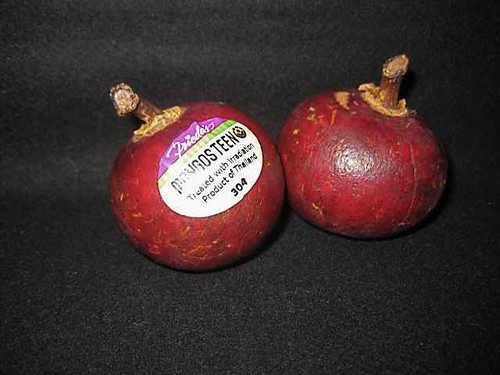
Luckily, with only a minimum of gentle prompting, the folks at Frieda's rushed immediately to the rescue and sent me a pair of mangosteens overnight.
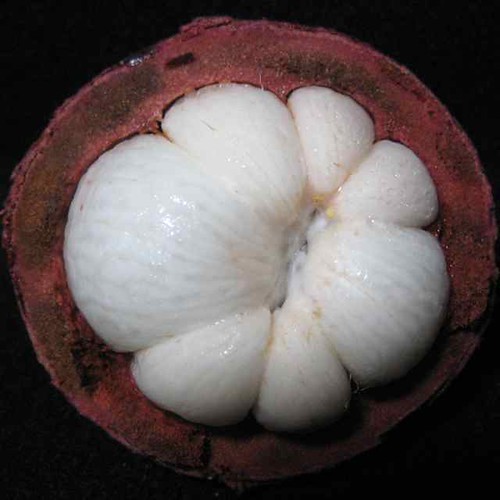
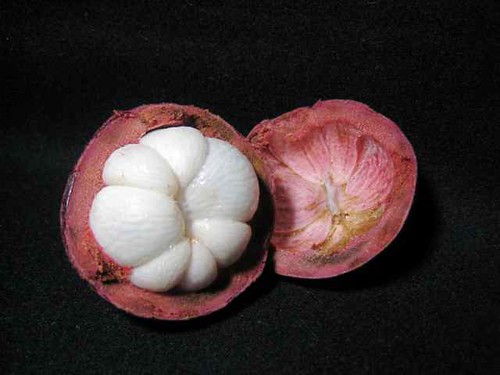
It had been a long day, the hottest we'd seen since moving to California, made longer by the fact that I spent much of it at home (our un-air-conditioned home) with a sick kid, and it wasn't until the children were in bed, the sun had set, and dinner had settled that we finally broke out the mangosteens. Lady Evil Fruit took some pictures, and we dug in. It was a little tougher to get out of the rind than I had expected, so although it looked nice in the pictures, I kind of mangled the first one trying to pry it out of the rind and into a bowl to serve. (The second one I just scooped out of the half-rind with a spoon and ate that way).
It was wonderful. I'm always a little worried trying fruits that people have raved about, because I worry I'll be disappointed, but I wasn't disappointed by this. Unfortunately, like trying to describe most fruits, words hardly do the flavor justice, but I'd put the strongest notes somewhere between apple and peach, but with definite berry, citrus, and other tropical flavors in there too. It was pleasantly but not obnoxiously sweet, with just a touch of acid.
I carefully saved the two big, flat seeds with the idea of germinating them (mostly just for the sake of doing it--I don't live somewhere that I could reasonably grow them), when it dawned on me that irradiation probably kills of seed embryos just as effectively as it does stowaway insects. Oh well.
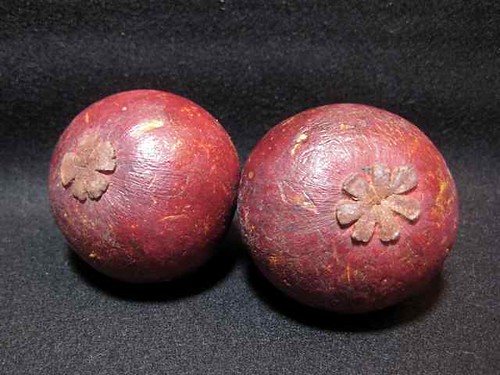
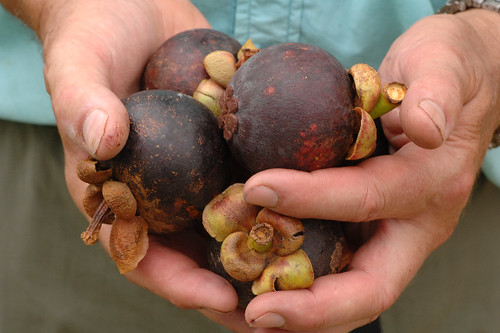
I was curious to note the absence of the distinctive green calyx on my mangosteens, and the thinner, brownish stems. I'm guessing the calyx and the outer layer of the stem were stripped off somehow?
I don't often include photos in my posts, and original photography is even rarer, so enjoy the photos below courtesy of my wife, the lovely Lady Evil Fruit:
Labels: Garcinia, mangosteens
posted by Evil Fruit Lord @ 11:06 PM
10 comments



 (Janick & Moore)
 (Janick & Moore)
 (USDA)
 (Deppe)
 (Pollan)
 (Hancock)
 (Ray)
(Ray)
 (Gollner)
 (Jackson)
 (Reich)
 (Bowling)
 (Trehane)
 (Singh)
 (Stuppy & Kesseler)
 (Staub)
 (Gordon)
 (Boning)
 (Juniper)
 (Yepsen)
 (Stilphen)
 (Koeppel)
 (Chapman)
 (Gough)
 (Gough)
 (Barney & Hummer)
 (Lazslo)
 (McGovern)
 (DeWolf)
 (Sullivan)
 (Munson)
 (Brantley)
 (Freinkel)
 (Taylor)
 (Train)
 (Levin)
 (Levin)
 (Kleinberg)
 (Darrow)
 (Hancock)
 (Maas, ed.)
 (Ashton)
 (Smith)
 (Pringle)
 (Campbell)
 (Sharma)
 (Musselman)