



Attack of the Mutant Cherries
Okay, they're not really attacking. But they are mutant cherries.
I've been neglecting my friends over at the Agricultural Biodiversity Weblog, but popping over there to catch up quickly turned up a fruit link:
Japanese Scientists Create Cherry Tree That Blossoms All Year Round (Telegraph)
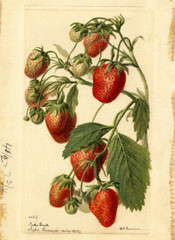
These sort of "everbearing" mutations have proven useful in a variety of of other crops, including strawberries (which are near and dear to me), but this may be the only one I know of that was artificially induced, rather than naturally occurring. (That said I'm skeptical about the prospects for this variety--the natural cycle of a plant is a critical component of its adaptation, and throwing one element of it completely out of whack like this can have serious detrimental effects. That can be okay in something like strawberry, where you're going to replant it yearly, but on a tree, the results can be a problem.)
Mutation breeding has a long history, though, and in fact one of the more important examples in fruit was also in cherry: the development of self-fertile varieties.
posted by Evil Fruit Lord @ 9:10 PM
330 comments



 (Janick & Moore)
 (Janick & Moore)
 (USDA)
 (Deppe)
 (Pollan)
 (Hancock)
 (Ray)
(Ray)
 (Gollner)
 (Jackson)
 (Reich)
 (Bowling)
 (Trehane)
 (Singh)
 (Stuppy & Kesseler)
 (Staub)
 (Gordon)
 (Boning)
 (Juniper)
 (Yepsen)
 (Stilphen)
 (Koeppel)
 (Chapman)
 (Gough)
 (Gough)
 (Barney & Hummer)
 (Lazslo)
 (McGovern)
 (DeWolf)
 (Sullivan)
 (Munson)
 (Brantley)
 (Freinkel)
 (Taylor)
 (Train)
 (Levin)
 (Levin)
 (Kleinberg)
 (Darrow)
 (Hancock)
 (Maas, ed.)
 (Ashton)
 (Smith)
 (Pringle)
 (Campbell)
 (Sharma)
 (Musselman)