



Fruit Genetics Friday #7: Plant Sex Chromosomes Part II: Strawberries
A couple weeks back, in the very infrequent Fruit Genetics Friday series, I discussed sex chromosomes in fruit, specifically papaya. At the time, the only two fruit crops I knew of with sex chromosomes were papaya and kiwi. Monday I opened my e-mail to a paper, forwarded to me by a friend who is also one of the authors, describing a very interesting development in this area:
Genetic mapping of sex determination in a wild strawberry, Fragaria virginiana, reveals earliest form of sex chromosome (Heredity)
(Unfortunately, for non-subscribers, this will just be an abstract, but I'll try to hit the good stuff).
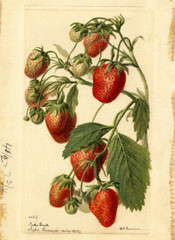
People were excited about the discovery of sex chromosomes in papaya, because it represented one of the most primitive sex chromosomes yet found in plants. Well, it turns out that F. virginiana, one of the ancestors of our cultivated strawberry, has sex chromosomes too (counter to what I said in that earlier post, incidentally), and these are even younger in their development! They're also really unusual in how they operate. In papaya and kiwi, as well as most other plants and lots of animals, the homogametic sex is the female (as in 'XX') and the heterogametic sex is male ('XY'). This seems to be the more typical arrangement, but strawberries, oddly enough, have the opposite arrangement.
So if you recall the arrangement in papaya, you had two critical loci. One, which we'll call "F" is a suppressor of femaleness, and the other is a promoter of maleness, which we'll call "M". So the two "wild type" chromosomes (which I'll call X and Y, since it puts it in terms people are familiar with and is essentially correct, even though the terminology isn't really used consistently in plants) consist of:
f---m (X chromosome)
F---M (Y chromosome)
So a female would be XX, or (fm)/(fm), so no maleness promoted and no femaleness suppressed. And male would be XY, with the femaleness suppressed, and maleness promoted. Hermaphrodites are generally a mutation of the Y chromosome (which we'll call the Y+ chromosome), so that the suppression of female development ceases to function, but male development still takes place:
(f)---M (Y+ chromosome)
So the sexes are basically female (XX), male (XY), and hermaphrodite (XY+). (because the YY isn't viable, you can't get a homozygous, true-breeding hermaphrodite).
Well, turns out strawberry has a different arrangement. The roles of the genes are kind of reversed. You have a dominant promoter of femaleness (which we'll call 'G' (for "gyn-", as used in the paper)), and a dominant gene for male sterility (which the paper calls 'A', as in "andro-"). And in this case we'll use Z and W (the system from birds) rather than the XY system.
So the arrangement is:
g---a (Z chromosome)
G---A (W chromosome)
So the sexes are female (ZW) and male (ZZ). This actually fits with some old research dating as far back as the 1920's suggesting that the female is the heterogametic sex. This was backed up by Ahmadi and Bringhurst, who suggested a single locus with three alleles, F, H, and M (in decreasing order of dominance). I kind of suspect many of these single locus, three allele systems, which have been proposed in other species as well, turn out to be variations on the two locus system, like in strawberry or papaya.
Here's a cool bit: The strawberry sex chromosome is pretty primitive, and so recombination in between these loci isn't fully suppressed, and you actually get crossover between them 5.7% of the time. As a result, you can get variations, namely hermaphrodites (resulting from a G/a recombinant) or a neuter (the result of a g/A recombinant). That suggests something which is only barely functioning as a sex chromosome.
Because the sex chromosome seems to have evolved very recently, what I'm curious about is how widespread in related species it is. I think it quite likely that the other major octoploid species, Fragaria chiloensis, and its offspring with F. virginiana, the cultivated F. x ananassa, share this scheme. But do the lower ploidy strawberries?
If diploid strawberries possessed sex chromosomes previous to the evolution of octoploids, then the octoploids should have eight sex chromosomes. Having this many would probably result in a mess (although it seems to work out alright for the short-beaked echidna), and the fact that sex inheritance seems to be pretty simple suggest that if the octoploid had eight sex chromosomes, then six of them have probably ceased to function as such.
Though there may be some exceptions (there are a bunch of east Asian diploid species I'm not really familiar with) the diploids I'm aware of, F. vesca, F. viridis, and F. nubicola seem to be almost (but not quite) uniformly hermaphrodite. Yet a number of higher ploidy species in addition to the octoploids, including the hexaploid F. moschata and the tetraploid F. orientalis are at least partially dioecious. It may be that polyploidy, by creating "backup" copies of the chromosomes possessing the sex controlling loci, allows divergence of one pair into more specialized sex chromosomes.
I'd be curious to know if closely-related genera such as Rubus and Potentilla share this system. Research suggests that in both of these species, the females are the heterogametic sex. If they possessed similar sex chromosomes, that would suggest that the strawberry's sex chromosomes have remained in their primitive state for a long time, or that something about the common ancestor was prone to the development of such an arrangement.
The other, perhaps less novel, but no less cool, aspect of the paper is that it introduces the first SSR-based map of the octoploid strawberry. Including two markers linked to the sex loci!
Anyway, all told, pretty cool, huh?
Labels: Fragaria, Fruit Genetics Friday, genetics, papaya, Potentilla, Rubus, sex, strawberries
posted by Evil Fruit Lord @ 12:03 AM
3 comments



 (Janick & Moore)
 (Janick & Moore)
 (USDA)
 (Deppe)
 (Pollan)
 (Hancock)
 (Ray)
(Ray)
 (Gollner)
 (Jackson)
 (Reich)
 (Bowling)
 (Trehane)
 (Singh)
 (Stuppy & Kesseler)
 (Staub)
 (Gordon)
 (Boning)
 (Juniper)
 (Yepsen)
 (Stilphen)
 (Koeppel)
 (Chapman)
 (Gough)
 (Gough)
 (Barney & Hummer)
 (Lazslo)
 (McGovern)
 (DeWolf)
 (Sullivan)
 (Munson)
 (Brantley)
 (Freinkel)
 (Taylor)
 (Train)
 (Levin)
 (Levin)
 (Kleinberg)
 (Darrow)
 (Hancock)
 (Maas, ed.)
 (Ashton)
 (Smith)
 (Pringle)
 (Campbell)
 (Sharma)
 (Musselman)