I tried posting this from a swimming pool in Mexico last Thursday, using my absolutely amazing little cellphone, but now that I'm home it seems it never got posted.
My job requires a number of trips a year to Mexico, and one of them was this past week. Trips for work are never quite as good as they would be if you were visiting the same place on your own time and resources (mostly because they involve a lot more work), and they're kind of a pain because they force you to put your family and life on hold for a few days, but at least in my company they kind of make it up to us by putting us up in pretty nice hotels (I got a suite even, because the rest of the rooms were booked) and feeding us really well.
We were sitting at dinner Wednesday night, chatting with my one of my Mexican colleagues, and the topic of pitaya came up (I think some of my colleagues had driven by a planting that day). A minute later, a plate of it arrived. We hadn't ordered it--in fact it wasn't even on the menu and to my knowledge we weren't charged for it. The waiter had overheard us talking about it and went and got the pitaya he had bought for himself at the market that day, just because he thought we'd like to try it.
As one of my colleagues, an American who lives in Mexico, said the next morning: that's Mexico. Despite the crushing poverty, the corruption, the crazy driving, the fact that nothing is
ever as simple as it seems it should be, there's still that Mexico, and perhaps because of that I'm finding it makes it very hard not be fond of the place.
Anyway, on with the fruit part: There's some confusion over what's a "pitaya". This is the kind of confusion that results from the fact that the same common names get assigned to all sorts of things, and why I always try to include Latin names in my posts (Okay, not always, but frequently. More often than the average food blooger, anyway). The ones we were served were from the genus
Stenocereus, at least I'm fairly sure they were. The related
Hylocereus also produces fruit sometimes referred to as "pitayas", though I think I'd prefer to reserve that name for the
Stenocereus, and call the
Hylocereus by their other name, dragon fruit (or my favorite, "Queen of the Night", although I suppose that's more for the plant than the fruits). You can also spell it with or without the "h". The Seris people of northern Mexico refer to
Stenocereus gummosus as "ziix is ccapxl". While this looks like something the old computer game "Trade Wars" used to generate as names for aliens (I remember well my arch-nemesis in that game, Fishe Siopx), it actually means "Thing whose fruit is sour". (Here's a link to a page describing cultivation of
Stenocereus. (Sorry about the Spanish thing, but if I put up with it for three days you can put up with it long enough to run it through Babelfish...).
Both species are cacti, and the
Stenocereus are organ pipe cacti, big, tall, columnar things, while the
Hylocereus are more vine-like. There are actually an assortment of different
Stenocereus species that are considered food crops, and I'm not going to try to hazard a guess on which we might have been served, because A) I haven't got a clue what the differences are, and B) even if I did I think that peeled and cut up they might be difficult to spot anyhow. There were three distinct colors on the plate: white, orange, and red. I didn't get to try the orange (it was one small plate for ten people) but I did get the white and red. The white was sweeter, though not overwhelmingly so, with the sort of mix between sweet and watery blandness that makes watermelon both incredibly refreshing to eat on a hot day and slightly insipid to me sometimes if I eat more than a few bites. The red one had less sugar, but a richer flavor, a more developed "fruit" taste. All colors had the same tiny seeds which crunched easily between your teeth, a little reminiscent of kiwi seeds. Red and white were both really good, at least in the small quantity presented.
The next morning I had what I think was a drink made from the white pitaya, too, although I could be wrong, because it was too early in the morning to really test the limits of my Spanish by asking the waiter what it was (it was in a pitcher on the table).
Anyway, I added another fruit to my life list, so it was a business trip well-spent.
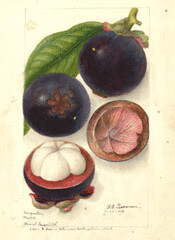
(I've got a half-finished mangosteen post to get up here in the next day or two, too, that I put on hold to go to Mexico...don't let me forget it this weekend.)
Labels: cacti, Mexico, pitaya, Stenocereus





 (Janick & Moore)
 (Janick & Moore)
 (USDA)
 (Deppe)
 (Pollan)
 (Hancock)
 (Ray)
(Ray)
 (Gollner)
 (Jackson)
 (Reich)
 (Bowling)
 (Trehane)
 (Singh)
 (Stuppy & Kesseler)
 (Staub)
 (Gordon)
 (Boning)
 (Juniper)
 (Yepsen)
 (Stilphen)
 (Koeppel)
 (Chapman)
 (Gough)
 (Gough)
 (Barney & Hummer)
 (Lazslo)
 (McGovern)
 (DeWolf)
 (Sullivan)
 (Munson)
 (Brantley)
 (Freinkel)
 (Taylor)
 (Train)
 (Levin)
 (Levin)
 (Kleinberg)
 (Darrow)
 (Hancock)
 (Maas, ed.)
 (Ashton)
 (Smith)
 (Pringle)
 (Campbell)
 (Sharma)
 (Musselman)